
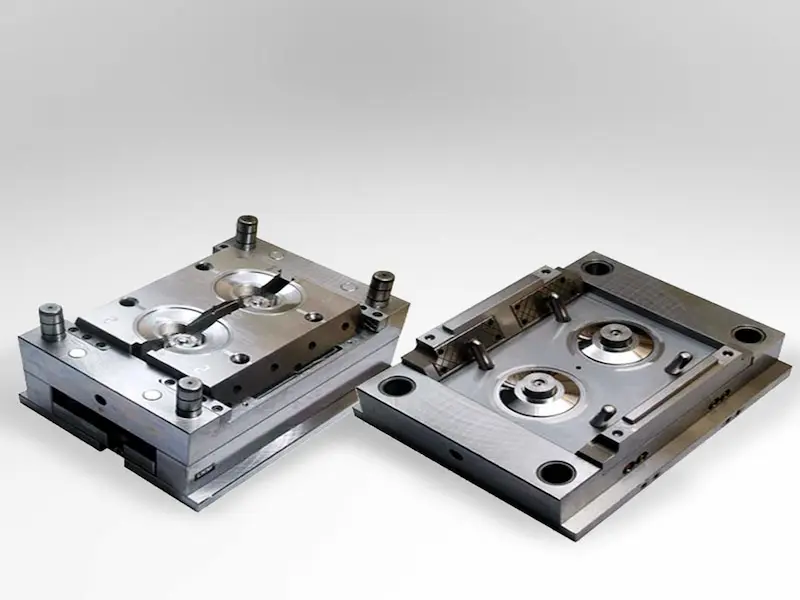
How to Reduce Deformation in Large-Area Injection Molded Parts
Deformation in large-area injection molded parts is one of the most common and difficult problems in plastic molding production. Because these parts usually have wide surface areas, uneven cooling, material orientation, and shrinkage differences can easily lead to warpage and dimensional instability. In practical production, several process and mold optimization methods can significantly improve deformation issues.
1. Use Multi-Point Water Cooling in the Mold
One effective way to reduce deformation is to improve the mold cooling layout. Changing the mold to a multi-point water cooling design can help maintain a more uniform mold temperature across the cavity surface.
For large-area injection molded parts, a mold with more cooling points usually performs better than a design with only a few cooling channels. Better cooling balance can reduce temperature differences inside the part, lower uneven shrinkage, and reduce the degree of molecular orientation caused by inconsistent flow and cooling conditions.
2. Increase Mold Temperature Properly
Appropriately increasing mold temperature can also help reduce deformation in large plastic parts. For ABS material, the mold temperature is often maintained above 60°C to slow down the cooling rate of the molded part.
Slower and more balanced cooling helps reduce deformation caused by rapid temperature change, internal stress, and uneven solidification. At the same time, a higher mold temperature can reduce excessive molecular alignment, which also helps improve dimensional stability.
3. Increase Injection Pressure or Holding Pressure
One of the most important methods for reducing deformation is to increase injection pressure or holding pressure and to extend the pressure holding time.
By increasing pressure and maintaining it for a longer period, the cavity can be packed more effectively. This helps compensate for material shrinkage, improves part density, and reduces dimensional variation across the molded surface.
In many production cases, extending the injection or holding pressure time by approximately 10 to 15 seconds can significantly improve warpage and deformation problems in large-area injection molded parts.
4. Improve Shrinkage Balance for Better Part Stability
The main purpose of these measures is to reduce uneven shrinkage and internal stress inside the part. When cooling is more uniform, molecular orientation is lower, and packing pressure is sufficient, the final plastic part is more likely to maintain a stable shape after ejection.
For large-area injection molded products, improving mold cooling design, setting a suitable mold temperature, and optimizing holding pressure are often the most practical and effective ways to control deformation.