
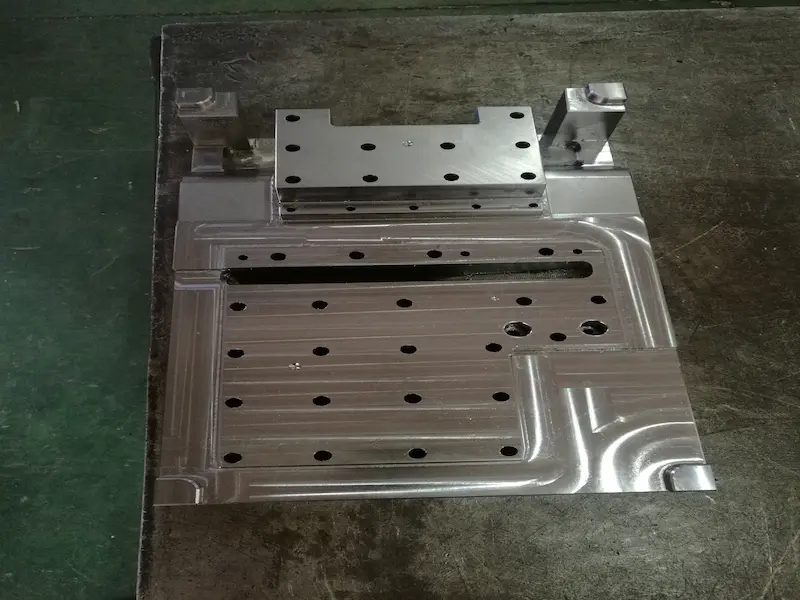
Key Design Considerations for Aluminum Extrusion Dies
Aluminum extrusion die design directly affects profile dimensional accuracy, surface quality, metal flow balance, and mold life. A properly designed die can improve production efficiency, reduce trial modifications, and ensure consistent extrusion quality.
1. Dimensional Analysis of Aluminum Extrusions
The size and dimensional deviation of aluminum extrusions are influenced by multiple factors, including die design, extrusion equipment, and process conditions. Among these factors, die size variation has the greatest impact.
The main reasons for mold size changes include elastic deformation of the die, temperature rise during extrusion, mold material properties, manufacturing precision, and mold wear.
Selection of Extrusion Press Tonnage
The extrusion ratio is an important value used to evaluate the difficulty of profile extrusion. In general, suitable extrusion ratios range from 10 to 150.
- If the extrusion ratio is below 10, the mechanical properties of the product may be insufficient.
- If the extrusion ratio is too high, the profile may develop defects such as surface roughness, twisting, or angular deviation.
For most applications, solid aluminum profiles are often designed with an extrusion ratio of approximately 30, while hollow profiles are commonly designed with an extrusion ratio of approximately 45.
Determination of External Die Dimensions
The external dimensions of an extrusion die mainly include the die diameter and thickness. These dimensions are determined according to the profile size, profile weight, and overall strength requirements of the die.
2. Reasonable Calculation of Extrusion Die Size
When calculating die opening dimensions, engineers must consider multiple factors, including:
- The chemical composition of the aluminum alloy
- The profile shape and complexity
- Nominal dimensions and tolerance requirements
- Extrusion temperature
- The thermal expansion coefficient of both the die material and aluminum alloy
- Stretch straightening deformation after extrusion
- Extrusion force and elastic deformation of the die
For profiles with significant wall thickness variation, thin-wall sections and sharp corners should usually be enlarged appropriately to improve extrusion stability.
For flat, wide-wall profiles and profiles with large aspect ratios, the size of ribs and webs must also consider elastic deformation, plastic deformation, overall bending, and the distance from the center of the extrusion container.
Extrusion speed, puller devices, and downstream handling equipment can also influence the final die hole dimensions.
3. Reasonable Adjustment of Metal Flow Speed
Proper metal flow adjustment means ensuring that all points of the profile cross-section exit the die at approximately the same speed.
To achieve balanced flow, extrusion dies often use symmetrical hole arrangements and different sizing belt lengths according to profile shape, wall thickness, circumference, and distance from the center of the extrusion container.
In general:
- Thinner wall sections usually require shorter sizing belts.
- Complex profile areas require shorter sizing belts.
- Areas farther from the center of the extrusion cylinder often require shorter sizing belts.
When the sizing belt alone cannot effectively control flow, other structures may be added, such as flow angles, guide cones, obstruction angles, balance holes, guide molds, or modified split hole arrangements.
For thin-wall sections located far from the center of the container, flow angles or guide cones may be used to speed up metal flow. Conversely, for thick-wall areas or regions close to the center, obstruction angles may be used to slow the flow.
4. Ensuring Sufficient Mold Strength
Mold strength is a critical issue because extrusion dies operate under high temperature and high pressure conditions. To ensure adequate mold life and prevent cracking or failure, engineers must properly design the die structure and select suitable die materials.
Important factors affecting die strength include:
- Proper die hole arrangement
- Suitable mold material selection
- Reasonable die structure and shape
- Accurate extrusion force calculation
- Strength verification of dangerous sections
Different mold types require different strength checks:
- Flat dies generally require shear strength and bending strength analysis.
- Tongue dies and split dies require shear, bending, compressive, and tensile strength analysis.
In recent years, finite element analysis has become an effective method for evaluating stress distribution and strength in complex extrusion die designs.
5. Working Belt Width Design
The design of the working belt in split dies is more complicated than that of half dies because engineers must consider not only wall thickness and profile location, but also the influence of the splitter bridge.
Because metal flow is restricted under the splitter bridge, the die opening in these areas often needs to be thinner. The thinnest wall section under the bridge generally has the highest metal flow resistance.
As a general rule, the minimum working belt width should be approximately twice the local wall thickness. Areas with thicker walls or easier metal flow can use a proportionally wider working belt.
6. Empty Knife Structure in Die Holes
The empty knife structure refers to the cantilever support section located at the outlet end of the die working belt.
- When the profile wall thickness is greater than or equal to 2.0 mm, a straight empty knife structure is generally easier to manufacture.
- When the wall thickness is less than 2.0 mm, or when the profile includes a cantilever structure, an inclined empty knife design is often preferred.
Conclusion
Aluminum extrusion die design requires a careful balance of dimensional accuracy, metal flow control, structural strength, and manufacturability. Proper control of extrusion ratio, die size, working belt design, and metal flow speed can significantly improve profile quality and reduce mold correction cycles.
Advanced engineering tools such as finite element analysis can further improve die performance by helping designers predict stress concentration, optimize metal flow, and extend mold service life.