
Vacuum and Pressurization Sizing Methods for Plastic Profile Extrusion
In plastic profile extrusion, the sizing process plays an important role in maintaining dimensional accuracy, surface quality, and final profile shape. Two commonly used sizing methods are vacuum sizing and pressurization sizing.
Vacuum Sizing
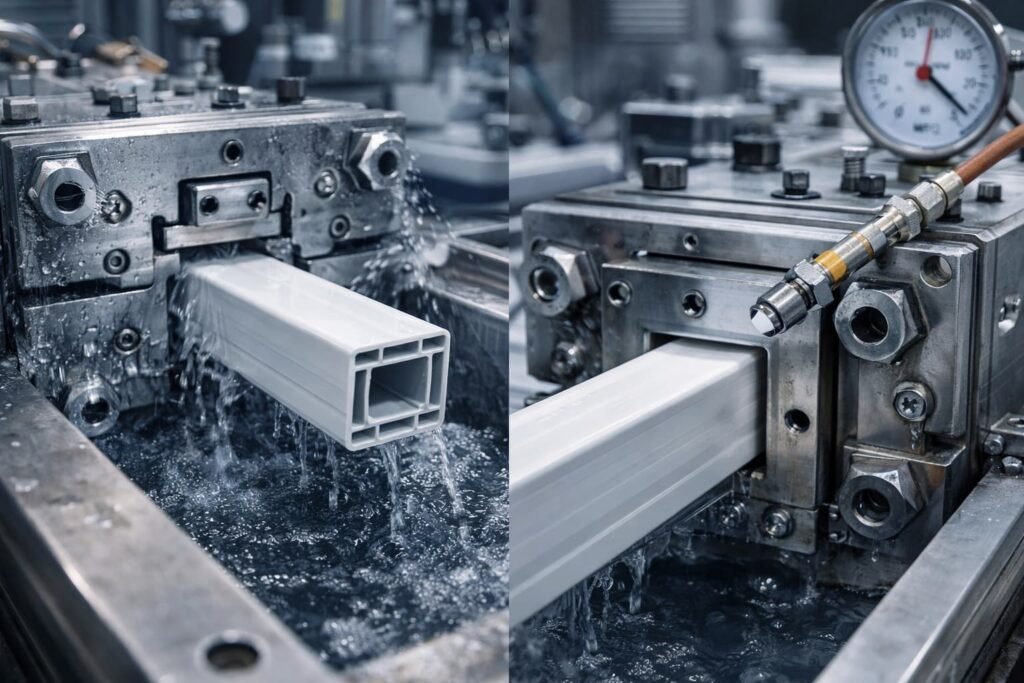
Vacuum sizing creates close contact between the extruded profile and the sizing device by drawing air through vacuum grooves and holes located on the outer wall of the calibrator.
For solid profiles without internal cavities, the process mainly relies on atmospheric pressure to press the profile against the cavity wall of the sizing device. However, for hollow profiles such as door and window frames, multiple sections of sizing devices are usually required. In many cases, the sizing system consists of three sections, each approximately 400 to 500 mm in length.
During the first sizing stage, the profile is plastically deformed under tension and pressure so that it closely matches the cavity shape of the sizing device. Special profile features such as grooves, ribs, or flanges are often formed in the later sizing sections to avoid blockage or deformation during the early forming stages.
Pressurization Sizing
Pressurization sizing mainly depends on compressed air introduced into the profile through the die core. The internal air pressure is typically maintained between 0.02 MPa and 0.1 MPa.
This internal pressure forces the outer surface of the profile tightly against the cavity wall of the sizing device. Because the profile remains in contact with the calibrator for a longer period under stable pressure, the final product can achieve higher dimensional accuracy, improved surface finish, and a smoother appearance.
Compared with vacuum sizing, pressurization sizing is especially suitable for hollow plastic profiles that require precise dimensions and better surface quality.