
What Is Rapid Prototyping and How Does RP Technology Work?
Rapid Prototyping (RP) technology is one of the most important developments in modern manufacturing over the past two decades. It breaks away from traditional machining methods by allowing digital designs to be transformed directly into physical prototypes, functional models, or even production-ready parts.
Rapid prototyping combines computer-aided design, digital modeling, scientific visualization, and advanced manufacturing technologies to create a direct connection between designers, engineers, manufacturers, and end users.
By making product concepts visible and touchable in a short period of time, RP technology helps companies reduce development risk, improve communication, and shorten the time needed to bring a product to market.
How Rapid Prototyping Works
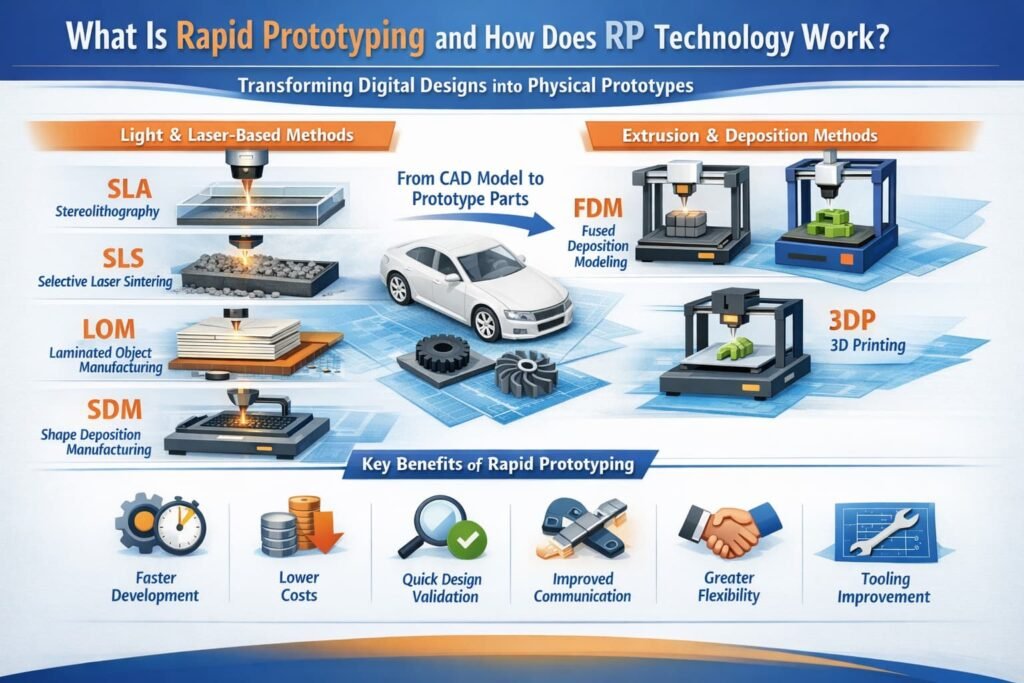
The core of rapid prototyping is digital manufacturing. A three-dimensional CAD model is converted into thin layers, and the prototype is then built layer by layer according to the digital data.
This process allows complex shapes, internal structures, and detailed features to be produced much faster than with conventional machining or mold making methods.
Depending on the application, rapid prototyping can be used to:
- Create visual concept models
- Produce functional prototypes
- Verify product structure and assembly
- Test ergonomics and appearance
- Manufacture prototype molds
- Create low-volume production parts
Main Advantages of Rapid Prototyping
Rapid prototyping offers several major advantages compared with traditional manufacturing methods.
- Shorter product development cycle
- Lower product development cost
- Faster design verification
- Better communication between designers and customers
- More flexibility for design changes
- Reduced tooling investment during early development stages
Because physical prototypes can be produced quickly, engineers can identify design problems earlier and make improvements before expensive tooling is built.
Two Main Categories of Rapid Prototyping Technology
Rapid prototyping systems are generally divided into two major categories based on how the material is formed.
1. Light-Based and Laser-Based Forming Technologies
These processes use lasers, ultraviolet light, or other energy sources to cure, fuse, or bond material layer by layer.
- Stereo Lithography (SLA)
- Laminated Object Manufacturing (LOM)
- Selective Laser Sintering (SLS)
- Shape Deposition Manufacturing (SDM)
SLA is widely used for highly detailed prototypes with smooth surfaces. SLS is often used for functional plastic parts and complex structures. LOM uses layered sheet materials, while SDM combines additive manufacturing with precision machining.
2. Extrusion-Based and Material Deposition Technologies
These processes build parts by depositing melted or bonded material layer by layer.
- Fused Deposition Modeling (FDM)
- Three Dimensional Printing (3DP)
FDM is one of the most widely used prototyping technologies because of its lower cost and material flexibility. 3DP technology can produce complex shapes quickly and is often used for concept verification and certain mold-making applications.
Why RP Technology Is Important in Manufacturing
Rapid prototyping has a major impact on product development, mold manufacturing, and production planning. It allows companies to reduce development time, improve product quality, and lower overall project cost.
For mold makers and manufacturers, RP technology is especially useful because it provides a faster way to test designs, verify assemblies, and evaluate manufacturability before moving into expensive tooling stages.
As manufacturing continues to move toward shorter lead times and more customized products, rapid prototyping technology will continue to play an increasingly important role in product development and industrial production. Because apparently making one prototype is no longer enough, now companies want three versions, two design changes, and a functional sample before lunch.