
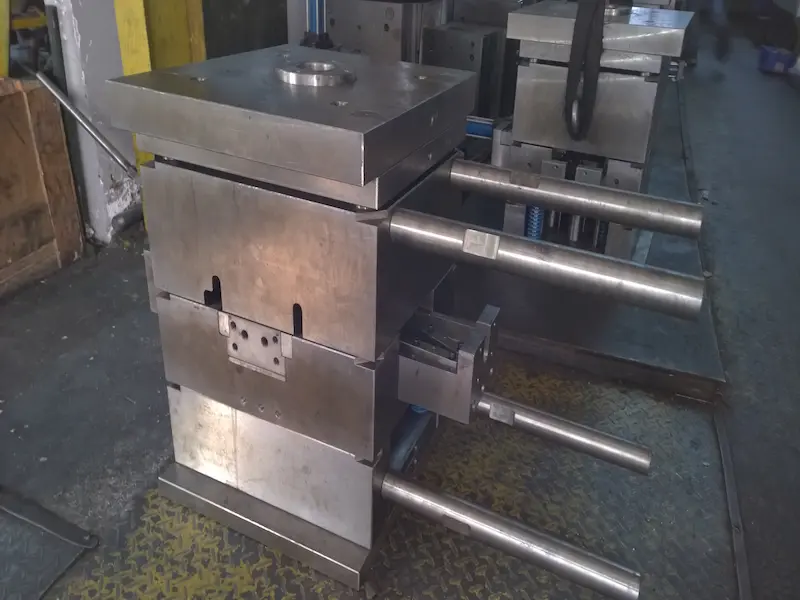
ProFoam Process for Lightweight Automotive Interior Parts
The ProFoam process is an advanced physical foaming technology used in injection molding to produce lightweight automotive interior parts with stable dimensions and high-quality surfaces. Combined with dynamic mold temperature control, this technology can create passenger car interior components with both a homogeneous foam structure and a high-gloss appearance.
In ProFoam technology, supercritical nitrogen is introduced into the raw material before it enters the injection molding barrel. This approach allows the material to foam during the molding process without requiring additional shearing or special mixing functions on the screw.
1. How the ProFoam Process Works
The basic principle of the ProFoam process is to infiltrate the plastic material with supercritical nitrogen before plasticization. During injection molding, the nitrogen expands inside the melt and forms a fine, uniform foam structure throughout the part.
Because the gas is introduced before the material enters the barrel, the process can be implemented without major modifications to the screw structure. This simplifies processing while still achieving a consistent foaming effect.
2. Benefits of ProFoam Technology
Compared with conventional injection molding, ProFoam technology offers several important advantages for automotive interior applications:
- Reduced part weight
- Improved dimensional stability
- Lower risk of warpage and deformation
- Homogeneous foam structure
- High-quality surface finish
- Better reinforcement fiber length retention
In many applications, ProFoam can reduce the weight of molded parts by more than 13% compared with traditional injection molding methods.
3. Dynamic Mold Temperature Control for Surface Quality
One challenge in foam injection molding is maintaining a high-quality surface appearance. By combining ProFoam technology with dynamic mold temperature control, manufacturers can produce parts that not only have lightweight internal foam structures, but also smooth, high-gloss exterior surfaces.
This is especially important for visible automotive interior components where appearance, texture, and dimensional quality are critical.
4. Advantages for Fiber-Reinforced Materials
Another important benefit of ProFoam technology is that it helps maintain a greater average length of reinforcing fibers inside the molded part. Longer fiber retention can improve the mechanical properties of the finished component and support higher structural strength without significantly increasing weight.
This makes the process particularly suitable for fiber-reinforced automotive interior parts that require a balance between lightweight construction and mechanical performance.
5. A Suitable Solution for Lightweight Vehicle Design
As the automotive industry continues to focus on lightweight design, ProFoam technology provides an effective solution for reducing part weight while maintaining appearance, stability, and performance. The combination of physical foaming and dynamic mold temperature control makes it possible to produce advanced interior components with lower material usage and better overall quality.