
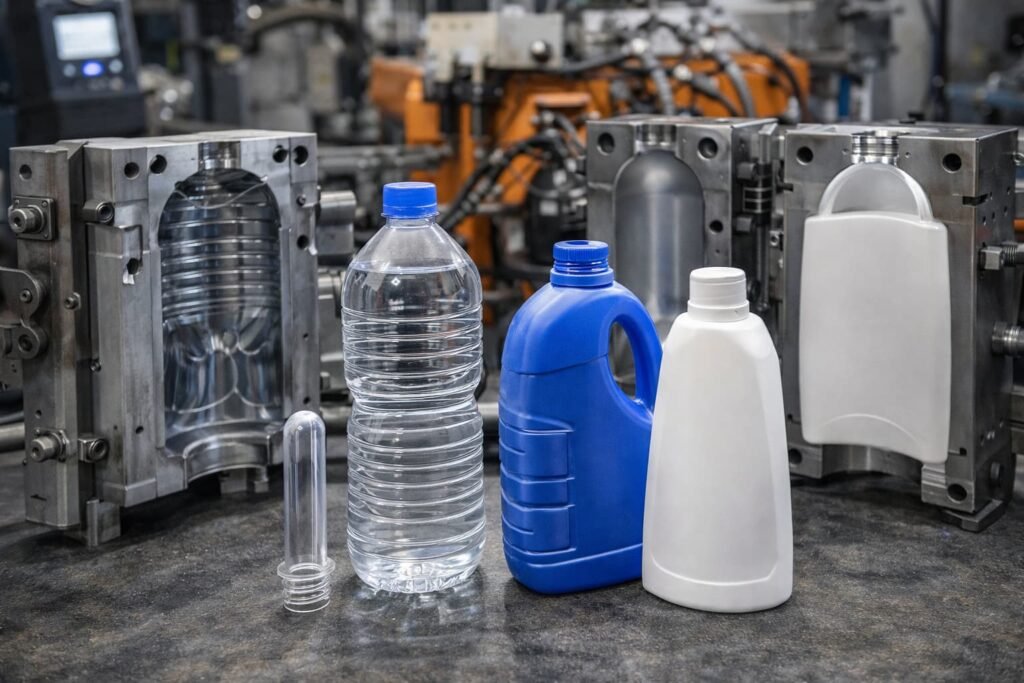
Plastic Blow Molds for Hollow Container Manufacturing
Plastic blow molds are used to manufacture hollow plastic products such as bottles, containers, tanks, drums, and packaging products. Common applications include beverage bottles, detergent bottles, cosmetic containers, chemical packaging, and automotive fluid tanks.
Blow molding is suitable for thermoplastic materials and is widely used because it can efficiently produce lightweight hollow parts with relatively simple mold structures and high production output.
What Is Blow Molding?
Blow molding is a manufacturing process in which heated plastic is formed into a hollow shape by air pressure inside a mold cavity. A softened plastic tube or preform is placed inside the mold, and compressed air is used to expand the material against the mold wall until the final shape is formed.
The equipment used for this process is generally called a blow molding machine. Compared with injection molds, blow molds usually have a simpler structure and lower tooling complexity.
Main Types of Blow Molding
Extrusion Blow Molding
Extrusion blow molding uses a continuously extruded plastic tube called a parison. The parison is captured inside the mold, inflated with compressed air, and cooled to create the final hollow product. This process is commonly used for large containers, bottles, and tanks.
Injection Blow Molding
Injection blow molding starts with an injection molded preform. The preform is then transferred into a blow mold where it is reheated and inflated into its final shape. This method offers better neck finish quality and more accurate dimensions.
Injection Stretch Blow Molding
Injection stretch blow molding is commonly used for PET bottles. In this process, the preform is stretched mechanically and inflated at the same time. This improves clarity, strength, and material distribution, making it ideal for beverage and water bottles.
Multi-Layer Blow Molding
Multi-layer blow molding combines different plastic materials into a layered wall structure. This process is often used when improved barrier performance, chemical resistance, or recycled inner layers are required.
Sheet Blow Molding
Sheet blow molding uses heated plastic sheet material to form hollow products. It is less common than extrusion or injection blow molding but can be suitable for certain packaging and industrial applications.
Advantages of Blow Molding
- Suitable for hollow products with complex shapes
- High production efficiency for bottles and containers
- Relatively simple mold structure compared with injection molds
- Lower mold cost for many packaging products
- Can produce lightweight parts with good material efficiency
Common Mold Materials
Blow molds are often manufactured from carbon steel, aluminum, or stainless steel, depending on production volume, cooling requirements, and product complexity. Aluminum molds are commonly used for faster heat transfer and shorter cycle times, while steel molds are preferred for longer production life.
Conclusion
Plastic blow molds are widely used for producing hollow containers and packaging products in industries such as food, beverage, cosmetics, chemicals, and automotive. With multiple process options including extrusion blow molding, injection blow molding, and stretch blow molding, manufacturers can select the most suitable method based on product requirements, volume, and material performance. Humans do seem strangely committed to putting every liquid on Earth into some kind of plastic bottle, so this process is not going away anytime soon.