
What Is Mold Sliding Injection Molding?
Mold sliding injection molding is a specialized two-step injection molding process developed for manufacturing hollow plastic products. The process is designed to produce hollow parts with better dimensional accuracy, more uniform wall thickness, and greater design freedom than many conventional hollow-part manufacturing methods.
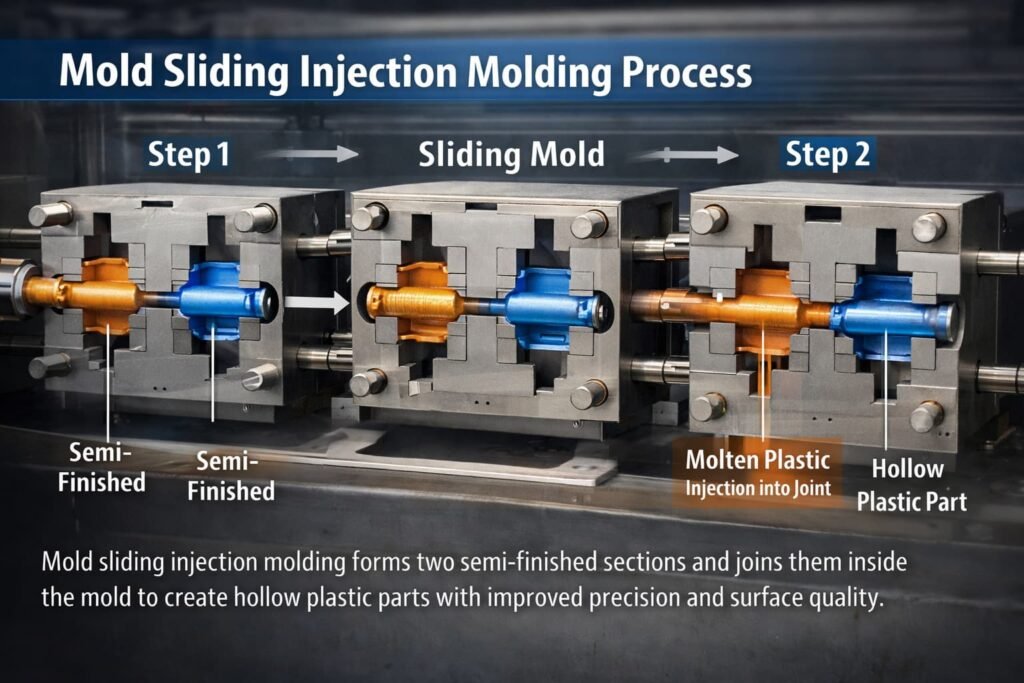
In this method, the hollow product is first divided into two separate sections. Each section is molded individually as a semi-finished part. After the first molding step, the semi-finished parts and mold components are shifted into a matching position by a sliding mold mechanism. The mold is then closed again, and molten plastic is injected into the joining area to fuse the two sections into one complete hollow product.
How Mold Sliding Injection Molding Works
The process typically follows two main molding stages. In the first stage, two matching half-sections of the product are injection molded. In the second stage, the mold slides so that the two semi-finished parts align at their mating surfaces. Additional molten plastic is then injected into the joint area to connect the two sections and form the final hollow part.
Because the semi-finished parts remain inside the mold during the process, their shape and alignment can be controlled more effectively than in secondary assembly methods that require the parts to be removed and reprocessed outside the mold.
Main Advantages of Mold Sliding Injection Molding
High dimensional accuracy: The process helps maintain better part precision because the semi-finished parts are not removed from the mold before final joining.
Good surface quality: Compared with many blow molded hollow products, mold sliding injection molding can achieve better surface finish and more refined part details.
Uniform wall thickness: The molding method supports more consistent wall thickness throughout the hollow product.
Greater design freedom: It is suitable for hollow products with more complex shapes that may be difficult to achieve with conventional hollow molding methods.
Improved joint quality: Since the joining step is completed inside the mold, the process can help reduce the risk of weld weakness associated with some secondary joining methods.
Advantages Over Secondary Welding Methods
For complex hollow products, mold sliding injection molding offers important benefits compared with secondary processes such as ultrasonic welding. In conventional secondary joining, the molded halves are removed from the mold, cooled outside the tool, and then welded together later. This can lead to dimensional variation and reduced weld quality.
With mold sliding injection molding, the semi-finished parts remain inside the mold throughout the process. This helps avoid shape deviation caused by cooling outside the mold and reduces the risk of lower joint strength caused by local stress during secondary welding.
Typical Applications
Mold sliding injection molding is mainly used for hollow plastic parts that require good appearance, high dimensional stability, and more complex structural design. It is particularly suitable for products where uniform wall thickness and reliable joining quality are important.
Conclusion
Mold sliding injection molding is an effective solution for producing hollow plastic parts with improved precision, better surface quality, and greater design flexibility. By molding two semi-finished sections and joining them inside the mold, the process helps overcome many of the limitations of conventional hollow molding and secondary welding methods.