
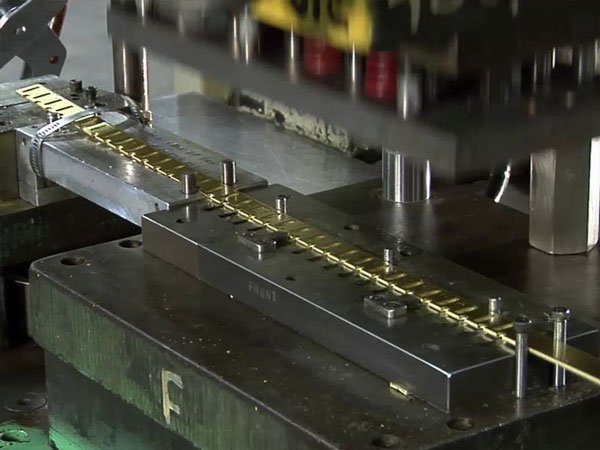
Common Progressive Die Problems in Pre-Cutting, Riveting, and Strip Feeding
In progressive die stamping, problems such as pre-cut tab drop, riveting station tab drop, and unstable auxiliary strip feeding can directly affect stamping quality, production stability, and die performance. To improve reliability in mass production, these issues should be analyzed based on die structure, punch height, strip control, and feeding mechanism accuracy.
1. Pre-Cutting Station Tab Drop
The possibility of tab drop at the pre-cutting station is mainly related to the pre-cut amount and the condition of the pre-cut die. In an ideal working condition, the pre-cut small square tab should remain connected to the strip while the auxiliary strip is transferred to the riveting station. If the tab drops too early, the pre-cut amount is usually too large and the punch height should be reduced.
It is also necessary to check whether material is sticking inside the pre-cut die. If the scrap or tab is trapped, the die may not have enough stripping or return force. In this case, the spring compression of the large elastic discharge bar should be adjusted to improve material return and stripping performance. By controlling these factors, the problem of tab drop at the pre-cutting station can be reduced.
2. Riveting Station Tab Drop
Tab drop can also occur at the riveting station. The main causes are usually insufficient pre-cut amount, inadequate punch height at the pre-riveting cutting position, or unstable bottom dead center of the press.
If the pre-cut amount is too small, the small square tab may not separate properly from the auxiliary strip when it reaches the pre-riveting position. If the cutting punch height is insufficient, the cutting effect will also be poor. In addition, if the press bottom dead center is unstable, the die shut height may fluctuate, which affects both the pre-cutting station and the pre-riveting station.
When tab drop occurs at the riveting station, the die limit posts should be used as the first reference point. The gap change between the upper and lower die limit posts can be measured with a feeler gauge to determine whether the die shut height has shifted. After confirming this, the cause can be eliminated step by step to improve the problem.
3. Unstable Auxiliary Strip Feeding
If auxiliary strip feeding is not smooth, the separation between the pre-cutting station, riveting station, and forming mechanism may become unreliable. In this case, the stripping force acting on the auxiliary strip can be increased so that the strip separates more smoothly and consistently after each stamping cycle.
If the feeding mechanism shows back movement or inaccurate feeding, the anti-return mechanism should be checked carefully. The anti-return device must provide an effective one-way holding function for the strip. If this function is insufficient, the anti-return mechanism can be adjusted slightly in the direction opposite to strip feeding, usually by about 0.05 mm to 0.1 mm, to improve feeding stability and positioning accuracy.
Why Process Control Matters in Progressive Die Stamping
In progressive die production, stable strip control, consistent shut height, proper pre-cut amount, and accurate feeding are all essential for reliable stamping performance. By analyzing these factors and adjusting the die and feeding system accordingly, manufacturers can reduce defects, improve production consistency, and increase die reliability in continuous stamping operations.