
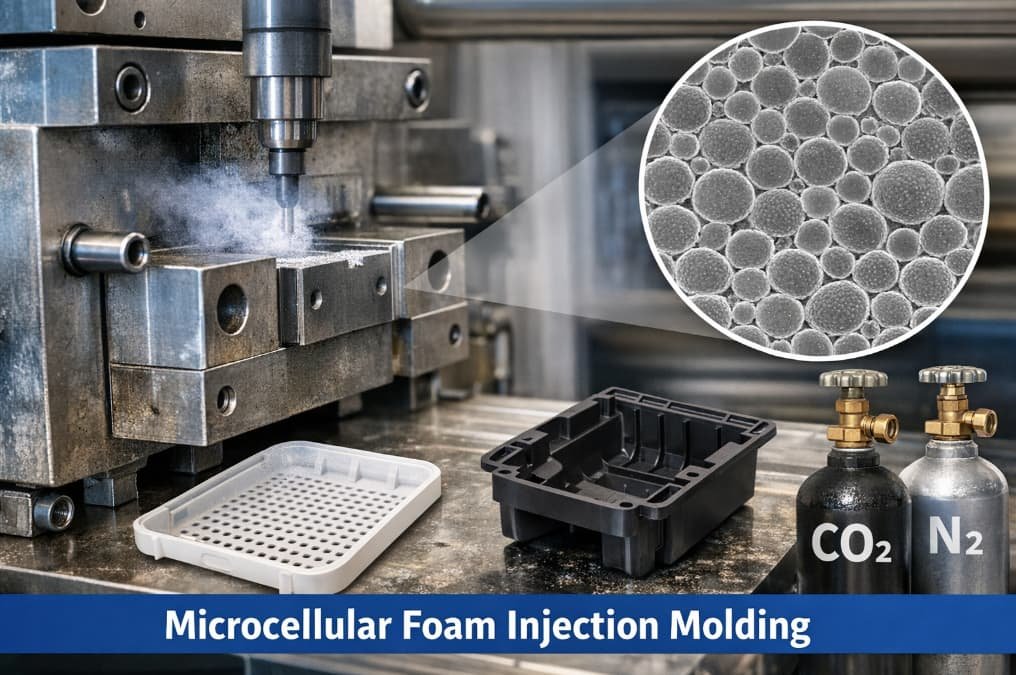
What Is Microcellular Foam Injection Molding?
Microcellular foam injection molding is an advanced molding process that uses supercritical inert gases such as CO₂ or N₂ as physical foaming agents. Compared with conventional structural foam molding, this process creates much finer and more uniform cells inside the plastic part, making it suitable for lightweight components with improved dimensional control and more complex geometries.
In traditional structural foam injection molding, chemical foaming agents are commonly used. Because the foaming pressure is relatively low, the final product is often limited in wall thickness, shape complexity, and internal cell uniformity. Microcellular foam injection molding addresses these limitations by introducing supercritical gas directly into the polymer melt.
How the Process Works
Microcellular foam injection molding is typically divided into four main stages:
1. Gas Dissolution
A supercritical inert gas is injected into the polymer melt to form a homogeneous polymer-gas solution under controlled temperature and pressure conditions.
2. Nucleation
As the melt flows into the mold cavity and pressure drops, the dissolved gas begins to come out of solution, forming a large number of fine and uniform cell nuclei.
3. Cell Growth
The cells expand under controlled thermal and pressure conditions, creating the microcellular structure inside the molded part.
4. Solidification
Once the cells reach the desired size, the part is cooled and stabilized, locking in the final structure.
How It Differs from Conventional Physical Foaming
Microcellular foam injection molding differs significantly from general physical foaming processes. One key difference is the much higher concentration of dissolved inert gas in the polymer melt. This allows the process to achieve a more uniform polymer-gas system that is difficult to obtain with conventional methods.
Another major difference is the nucleation behavior. In conventional foam molding, thermodynamic changes are often slower, which can result in larger cells and uneven cell distribution. In microcellular molding, the thermodynamic state changes rapidly, leading to a much higher nucleation rate and a finer, more consistent cell structure.
Main Advantages of Microcellular Foam Injection Molding
Microcellular foam molding offers several practical advantages over conventional foam molding processes:
Thin-wall capability: The process produces very small cells, making it possible to mold thin-walled parts, including sections around 1 mm, that are difficult to achieve with conventional foam structures.
Fine closed-cell structure: The resulting microcellular foam typically has a closed-cell structure, which can support lightweight designs and certain barrier-related applications.
Cleaner processing: Since CO₂ or N₂ is used as the foaming medium, the process avoids many of the environmental concerns associated with chemical foaming agents.
Conclusion
Microcellular foam injection molding is a valuable process for manufacturers looking to reduce weight, improve part consistency, and produce thinner or more complex plastic components. By using supercritical inert gas and controlled nucleation, it offers clear advantages over conventional foam molding in both part quality and process capability.