
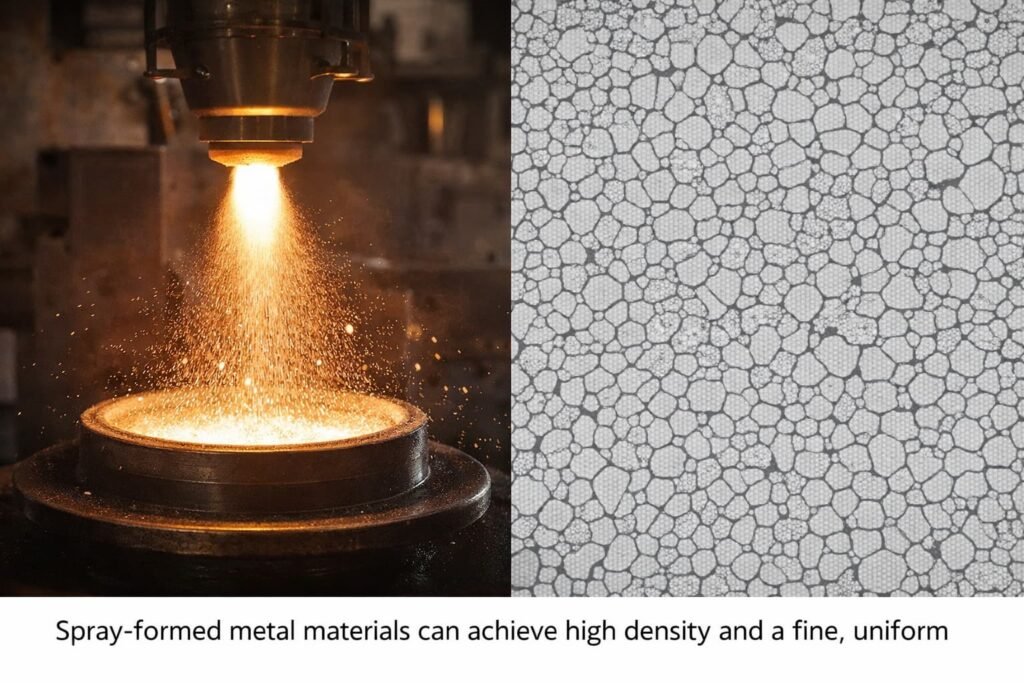
Microstructure Characteristics of Spray-Formed Metal Materials
Spray-formed metal materials have unique microstructural characteristics that help improve density, grain uniformity, and overall mechanical performance. Compared with traditional press-forming powder metallurgy processes, spray forming can produce materials with a finer internal structure, higher relative density, and more consistent material properties.
1. High Structural Density
During spray forming, atomized metal droplets are continuously deposited, impact-deformed, partially remelted, and rapidly solidified on the deposition surface. This repeated filling and consolidation action helps reduce internal voids and close micro-pores within the material.
As a result, spray-formed metal materials generally contain fewer and smaller pores than conventional powder metallurgy products.
2. High Relative Density
Because the remaining pores are usually small and discontinuous rather than interconnected, spray-formed metal materials can achieve a relative density of approximately 95% to 98%. This is typically higher than that of conventional press-formed powder metallurgy parts.
3. Fine and Uniform Grain Structure
The diameter of atomized droplets is typically around 100 μm, which provides a large surface-area-to-volume ratio and allows rapid heat dissipation during deposition and solidification. This helps form a fine and uniform grain structure throughout the material.
4. Formation of a Microcrystalline Structure
When metal droplets strike the deposition surface, they undergo rapid cooling and accelerated solidification. This process can form a microcrystalline structure that helps retain the desirable properties of high-performance powder metallurgy tool steels, including high hardness and good wear resistance.
5. Improved Overall Material Performance
Compared with traditional press-forming methods, spray-formed metal materials generally offer a more uniform microstructure, higher density, and better overall performance. These characteristics make them suitable for demanding engineering applications that require strength, dimensional stability, and consistent quality.