
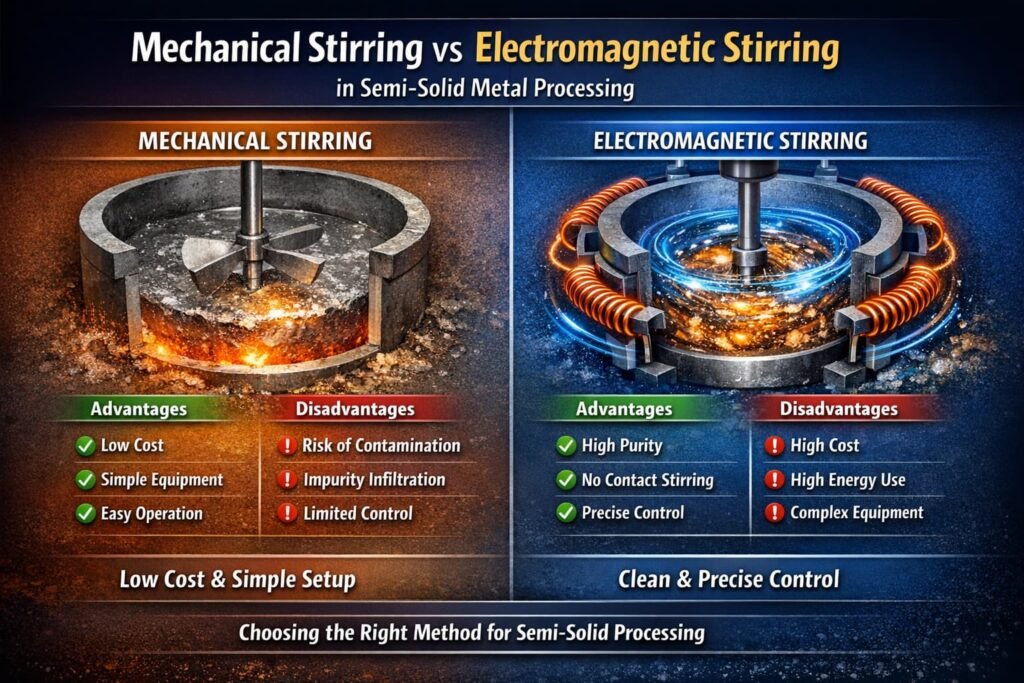
Mechanical Stirring vs Electromagnetic Stirring in Semi-Solid Metal Processing
Mechanical stirring and electromagnetic stirring are two commonly used methods for producing non-dendritic structures in semi-solid metal processing. Both methods aim to refine the grain structure, improve alloy flow behavior, and create fine equiaxed grains for better forming quality.
1. Mechanical Stirring Method
The mechanical stirring method is one of the oldest and simplest techniques used in semi-solid processing. Unlike electromagnetic stirring, mechanical stirring uses rotating blades or stirring rods to agitate the alloy in a semi-solid state.
The formation principle of non-dendritic grains is similar to other stirring methods. The rotating stirring tool applies shear force to the alloy, which helps break dendritic structures and promotes the formation of fine equiaxed grains.
The solid phase ratio of the alloy is controlled by adjusting the surrounding temperature of the material. The shear rate mainly depends on the rotational speed of the stirring rod or blade.
Advantages of Mechanical Stirring
- Simple equipment structure
- Low manufacturing and operating cost
- Easy to operate and control
- Suitable for basic semi-solid processing applications
Disadvantages of Mechanical Stirring
- Limited stirring speed and lower production efficiency
- Difficult to maintain a sealed processing environment
- Higher risk of introducing impurities and gas into the alloy
- More likely to produce pores and contamination defects
2. Electromagnetic Stirring Method
Electromagnetic stirring uses electromagnetic induction to agitate molten or semi-solid metal. A rotating magnetic field is applied outside the metal solution, causing the molten metal to move and generate induced currents.
The interaction between the magnetic field and the induced current creates strong stirring inside the alloy, which promotes the formation of non-dendritic grains and improves structural uniformity.
The stirring speed can be controlled by adjusting the magnetic field strength and the rotation speed of the magnetic field. Rotating magnetic fields are generally created in two ways:
- Applying alternating current to induction coils
- Using permanent magnets driven by a motor
Advantages of Electromagnetic Stirring
- No direct contact with blades or stirring rods
- Higher alloy purity and lower contamination risk
- Can be performed in a sealed container
- Reduces gas absorption and porosity defects
- Provides more precise and adjustable stirring control
- Offers a wider control range for stirring speed
Disadvantages of Electromagnetic Stirring
- Higher energy consumption
- Higher equipment and production cost
- Billet manufacturing is more expensive
- Less suitable for large-size component production
Conclusion
Mechanical stirring and electromagnetic stirring both have important roles in semi-solid metal processing. Mechanical stirring is simple, cost-effective, and suitable for basic production needs, while electromagnetic stirring provides better purity, more precise control, and lower defect rates.
The choice between these two methods depends on the alloy type, required quality level, production scale, and manufacturing budget. Humans, naturally, managed to invent one process that is cheap but messy, and another that is clean but expensive. Industrial engineering in one sentence.