
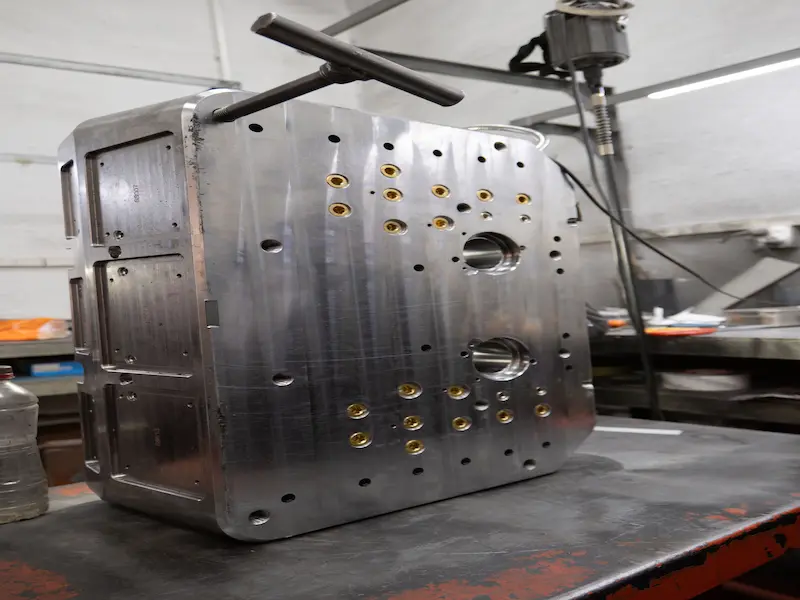
How to Select Die Casting Mold Materials for Longer Tool Life
Material selection is one of the most important factors affecting die casting mold life. A suitable mold steel must not only provide good machinability and polishing performance, but also maintain stable mechanical properties under repeated high-temperature working conditions.
In die casting production, the mold is exposed to thermal shock, molten metal erosion, oxidation, and cyclic mechanical loading. If the mold material does not have sufficient toughness, thermal fatigue resistance, and hot hardness, premature cracking, soldering, and wear can occur.
Key Requirements for Die Casting Mold Materials
A high-quality die casting mold material should offer the following characteristics:
- Good machinability for efficient mold making and easier finishing
- High hardenability to achieve a uniform microstructure and stable properties after quenching
- Low heat treatment deformation to maintain dimensional accuracy
- High-temperature plasticity and thermal fatigue resistance to reduce early cracking
- High-temperature strength, hardness, and wear resistance for stable long-term performance
- Low thermal expansion coefficient to improve dimensional stability during use
- Strong resistance to chemical erosion and mechanical erosion from molten die casting alloys
- Good oxidation resistance at high temperature and corrosion resistance at room temperature
Why Chemical Purity Matters
For commonly used H13 steel and similar hot work tool steels, chemical purity has a direct effect on impact toughness and crack resistance. Lower sulfur and phosphorus levels help reduce impurities and improve the steel’s internal quality.
High-purity mold steels with controlled sulfur and phosphorus content can provide better thermal fatigue resistance, improved toughness, and more stable die performance. Reducing eutectic carbide inclusions and other impurities is also important, because these defects can become crack initiation points during repeated thermal cycling.
Importance of Steel Uniformity
Uniform steel structure is essential for reliable mold performance. The mold steel should have consistent mechanical properties in different directions, including longitudinal, transverse, and depth directions. Good structural uniformity helps reduce local weakness and improves resistance to cracking and deformation.
Electroslag remelting (ESR) refined steels are often preferred for high-performance die casting molds because they offer:
- Higher purity
- More compact internal structure
- Better thermal fatigue resistance
- Improved thermal crack resistance
- Better toughness and ductility
- Excellent polishing performance
Common Mold Steel Grades for Die Casting Molds
For die casting molds with high life requirements, manufacturers often choose proven hot work tool steels with strong toughness and high-temperature strength. Commonly referenced grades include:
- 8407
- DIEVAR
- 1.2344
- H13
- SKD61
- DAC55
- ZHD435
These materials are widely used because they provide a good balance of hot hardness, toughness, thermal fatigue resistance, and durability in demanding die casting applications.
How Better Mold Materials Improve Die Life
Proper selection of mold materials and high-strength alloy steels can significantly increase mold life. High-quality hot work tool steels help reduce cracking, soldering, erosion, and premature wear, which lowers maintenance frequency and improves production stability.
For manufacturers producing aluminum, zinc, or magnesium die cast parts, choosing the right die material is essential for maintaining dimensional consistency, reducing tooling costs, and supporting long production runs.
Conclusion
Die casting mold materials should be selected based on machinability, heat treatment response, hot strength, thermal fatigue resistance, purity, and resistance to molten alloy attack. High-purity and ESR-refined hot work tool steels are especially suitable for molds that require long service life and stable performance.
By selecting the right mold steel from the beginning, manufacturers can improve mold durability, reduce downtime, and achieve more reliable die casting results.