
Low Pressure Casting vs Investment Casting: Advantages and Limitations
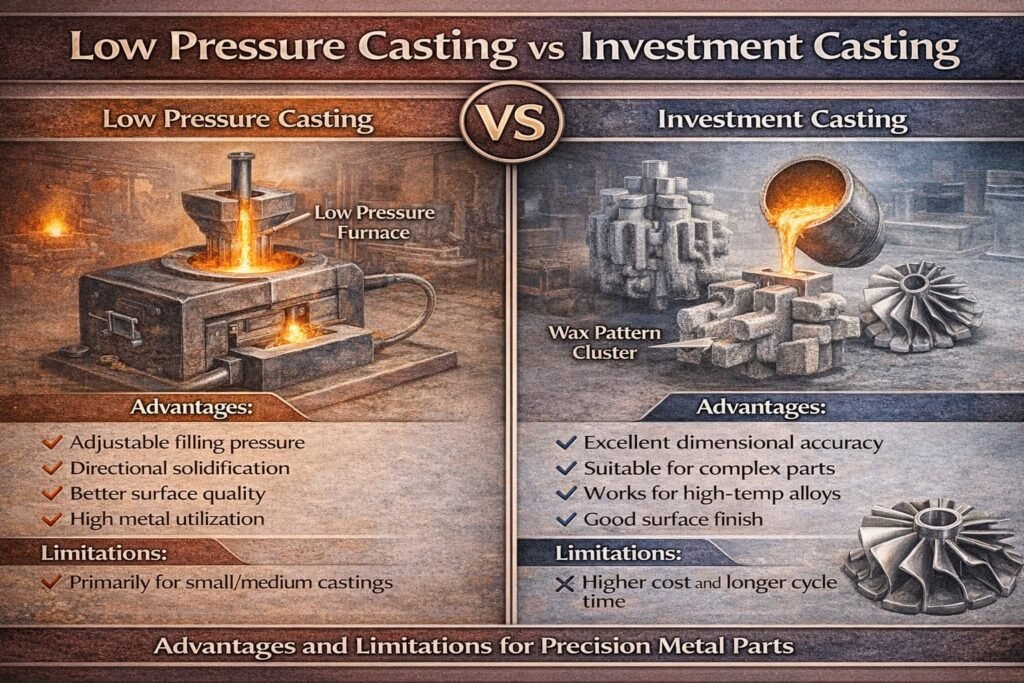
Low pressure casting and investment casting are two important metal casting processes used for different production needs. Each method offers distinct advantages in terms of filling performance, casting quality, dimensional precision, material utilization, and alloy suitability. At the same time, both processes also have practical limitations that must be considered during product development and manufacturing planning.
Advantages of Low Pressure Casting
Low pressure casting offers stable and controllable metal filling. The pouring pressure and filling speed can be adjusted easily, allowing the process to adapt to different mold types. Because the metal enters the cavity smoothly, the impact on the mold is relatively small, and gas can be discharged more easily during filling.
Another major advantage is that low pressure casting supports directional solidification more effectively. This helps reduce shrinkage defects and can be especially useful for improving the internal quality of aluminum alloy castings, including the reduction of pinhole defects.
Low pressure casting can also produce castings with better surface quality than many conventional permanent mold methods. In suitable applications, thin-walled parts with wall thicknesses of around 1.5 to 2 mm can be produced.
Because risers are often not required, the metal utilization rate is high and can typically reach about 90% to 98%. In addition, equipment investment is generally much lower than that required for die casting, which makes the process attractive for certain medium-volume production programs.
Advantages of Investment Casting
Investment casting is known for its excellent dimensional accuracy and surface finish. Because the mold cavity is highly precise and there is usually no conventional parting surface on the final casting, the process can produce components with very smooth surfaces and fine detail.
This process is also highly suitable for complex and thin-walled parts. Since the shell mold is preheated before pouring, investment casting can achieve good filling performance even for geometries that would be difficult to produce by other casting methods.
Another important benefit is material versatility. The ceramic shell is made from high-grade refractory materials, so investment casting can be used for a wide range of alloys, including high-melting-point alloys and difficult-to-machine materials such as heat-resistant alloys, magnetic steels, and high-manganese steels.
Investment casting is also flexible in production volume. It can be used not only for mass production, but also for single-piece or small-batch manufacturing when high precision or complex geometry is required.
Limitations of These Processes
Despite their advantages, both processes have limitations. Investment casting requires relatively expensive materials, the process flow is more complicated, and the production cycle is longer than simpler casting methods. As a result, the casting cost is often several times higher than that of sand casting.
In addition, full mechanization and automation are more difficult to achieve in investment casting. The size of the castings is also limited, and the process is generally more suitable for small to medium parts rather than very large or very long components.
Conclusion
Low pressure casting is a strong choice when stable filling, good internal quality, high metal utilization, and improved surface finish are important. Investment casting is more suitable when the part requires complex geometry, excellent precision, superior surface quality, or special alloy materials. Selecting the right process depends on part size, alloy type, cost targets, production volume, and performance requirements.