
Laser Impact Forming and Laser Bending Technology for Sheet Metal
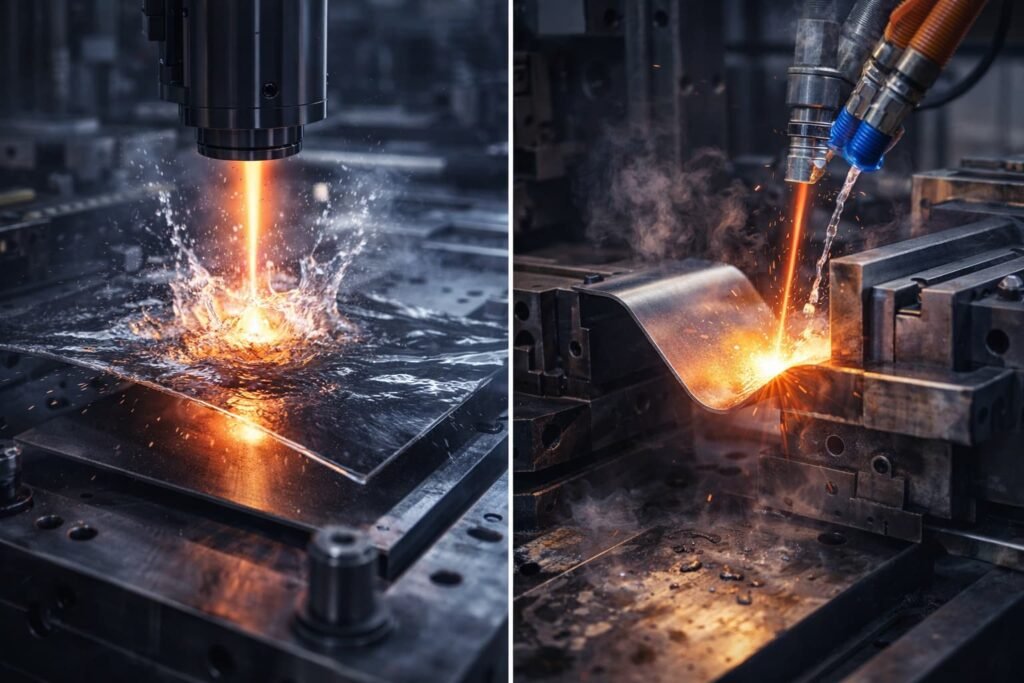
Laser impact forming is a process in which a coated sheet metal workpiece is irradiated with a laser beam to generate a shock wave that plastically deforms the material.
Before processing, the workpiece surface is usually coated with an opaque layer such as black paint. A transparent layer, often water, is then applied over the surface.
When the laser beam passes through the transparent layer and reaches the opaque coating, the coating absorbs the laser energy and rapidly evaporates. The evaporated material continues to absorb energy and becomes high-pressure gas.
Because the transparent layer restricts the expansion of the gas, a strong impact stress wave is generated. Part of this stress wave deforms the workpiece, while another part acts on the surface layer and creates residual compressive stress, improving surface strength and fatigue resistance.
Although the process generates significant heat, the workpiece surface temperature is usually only around 150°C, and the heating time lasts only a fraction of a second. As a result, the microstructure of the material is generally not affected.
Laser impact forming is considered a cold working process and is well suited for automated production applications.
Laser Bending Forming
Laser bending forming is another sheet metal processing method in which a laser beam heats a localized area of the workpiece surface.
After heating, cooling media such as water are used to rapidly cool the material. The rapid temperature change creates localized thermal stress, causing the workpiece to bend or deform in a controlled manner.
The amount of deformation depends on material properties, workpiece thickness, laser power, and processing parameters.
In most cases, laser bending operations are controlled through computer programs. To maintain dimensional accuracy and process stability, manufacturers need to regularly update material databases and process parameter libraries.
Because of its high precision, minimal tooling requirements, and suitability for automation, laser bending technology is increasingly used in modern sheet metal manufacturing.