
How Quenching Temperature Affects Tool Steel Performance
The selection of quenching temperature is one of the most important factors in tool steel heat treatment. In actual production, the upper and lower limits of the quenching temperature generally correspond to the maximum and minimum secondary hardening effects that can be achieved.
The temperature selected depends not only on the steel grade, but also on the size and shape of the workpiece, the required hardness, and the temperature control capability of the heat treatment equipment.
Tool Type Affects Quenching Temperature Selection
Different cutting tools require different quenching temperatures because their geometry, toughness requirements, and risk of distortion are different.
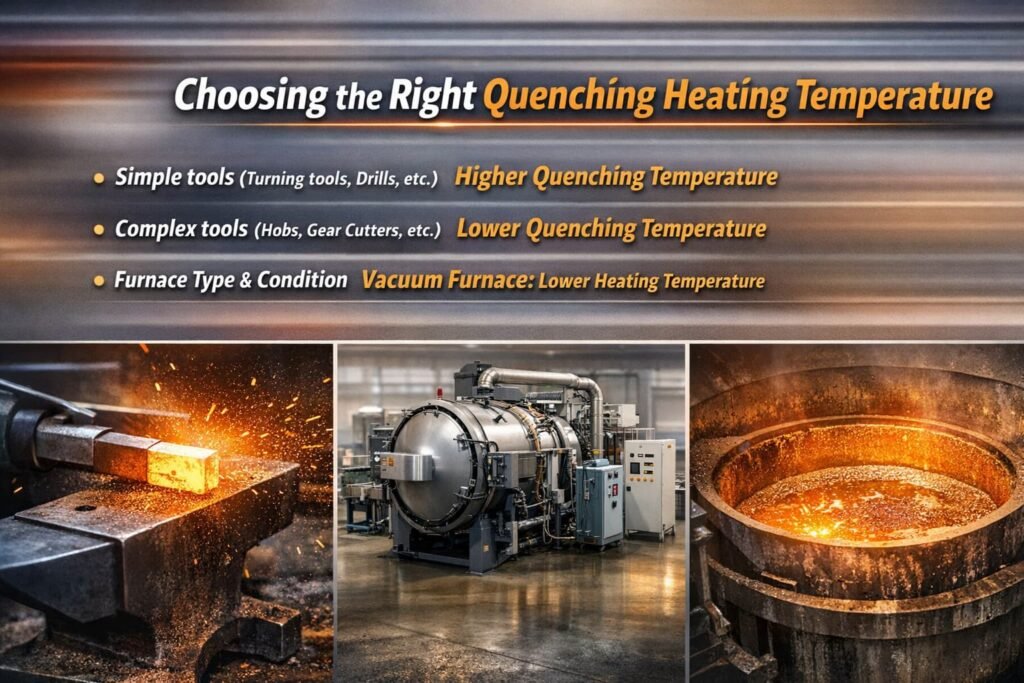
Simple tools such as turning tools, end mills, and drill bits usually have relatively simple shapes. Single-edge tools especially have lower toughness requirements and are less likely to deform during heat treatment. Because of this, they can generally use a higher quenching temperature to fully develop the red hardness potential of the steel.
Complex tools such as hobs, gear cutters, thin-section tools, and long slender tools usually require a lower or more moderate quenching temperature. These tools have more complicated shapes, thinner sections, and higher risks of deformation, cracking, or grain growth during heating.
How Workpiece Size Changes the Recommended Temperature
For many common tools such as turning tools and drills, larger workpieces can usually use a slightly higher quenching temperature. This is because the material structure inside larger and smaller raw materials is often similar, while larger workpieces may require deeper hardening and better red hardness.
However, some tools behave differently. Gear cutters and hobs are typical examples where larger sizes may require lower quenching temperatures instead.
This is because larger gear cutter materials often contain more uneven carbide distribution. In these cases, excessive heating may cause local overheating, grain coarsening, and carbide accumulation. To avoid these problems, both the quenching temperature and the holding time should be reduced appropriately.
Large gear cutters are also expensive, so manufacturers often use slightly lower temperatures to reduce the risk of damage during the quenching, tempering, and grinding process.
Furnace Type Also Influences Heating Temperature
The selection of quenching temperature is closely related to the type of furnace being used.
When using a vacuum furnace, the heating rate is generally slower and the soaking time is longer than in a salt bath furnace. Because of this longer heating process, the quenching temperature should usually be set slightly lower than the temperature used in a salt bath furnace.
If the same temperature is used for both furnace types, the material may experience grain growth, which can reduce toughness and negatively affect tool life.
Balancing Hardness and Safety
The best quenching temperature is always a balance between hardness, toughness, wear resistance, dimensional stability, and process safety.
Higher temperatures can improve hardness and red hardness, but they also increase the risk of grain growth, cracking, distortion, and overheating.
Lower temperatures improve process stability and reduce deformation, but they may also reduce the final hardness and wear resistance of the tool.
For this reason, quenching temperature should always be selected according to the tool type, size, material structure, and furnace condition to achieve the best balance between performance and manufacturing reliability. Because apparently even heating steel until it is glowing is still not simple enough for manufacturing people.