
What Is Injection-Compression Molding?
Injection-compression molding is a specialized plastic molding process developed for applications that require high surface quality, low internal stress, and excellent dimensional stability. It is widely used for optical components, thin-walled plastic parts, and other precision molded products that are difficult to produce consistently with conventional injection molding.
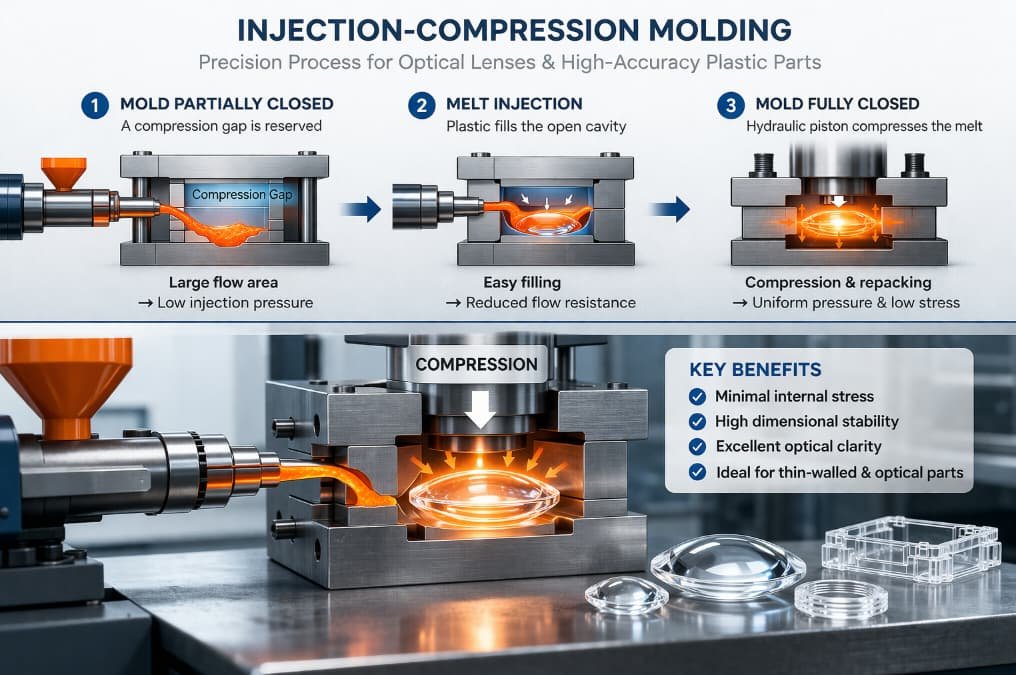
In this process, the mold is first clamped but not fully closed. A controlled compression gap is intentionally left between the fixed and movable mold halves. The molten plastic is then injected into the partially open cavity. After filling is completed, the mold closes fully and compresses the melt, allowing the material to flow again and compact more uniformly inside the cavity.
How Injection-Compression Molding Works
The process combines the filling stage of injection molding with a controlled compression stage. Because the cavity is not fully closed during injection, the melt flows through a larger passage area and encounters lower flow resistance. Once the material is inside the cavity, the mold closes completely and applies additional pressure directly to the melt.
This compression action helps compensate for material shrinkage, improves pressure distribution inside the cavity, and supports more uniform part formation.
Main Characteristics of Injection-Compression Molding
1. Lower Injection Pressure During Filling
Since the mold cavity is not fully closed during the initial injection stage, the melt can flow more easily. The larger flow area reduces resistance, which means the required injection pressure is lower than in standard injection molding.
2. More Uniform Cavity Pressure
After injection, the mold closes completely and compresses the material. This reduces cavity volume and applies pressure more evenly across the part, helping improve material consistency and final part accuracy.
Advantages of Injection-Compression Molding
Compared with general injection molding, injection-compression molding offers several important benefits:
Reduced molecular orientation: The process can reduce the orientation effects caused by conventional filling and packing.
Lower internal and residual stress: More uniform pressure distribution helps minimize stress inside the molded part.
Improved dimensional stability: Better cavity pressure control helps produce more accurate and stable parts.
Higher material uniformity: The compression stage improves melt distribution and packing consistency.
Better surface quality: The process is especially useful for products that require excellent optical or cosmetic surfaces.
Typical Applications
Injection-compression molding has been widely used in the production of plastic optical lenses and other high-precision components. It is also suitable for manufacturing laser disc substrates, thin-walled plastic parts, and certain glass fiber reinforced resin components where dimensional accuracy and reduced stress are important.
As demand for higher-quality precision plastic parts continues to grow, injection-compression molding is becoming an increasingly valuable process in advanced plastic manufacturing.
Conclusion
Injection-compression molding is an effective solution for producing precision plastic parts with lower stress, improved stability, and better surface quality. By injecting melt into a partially open cavity and then compressing it during final mold closure, the process offers clear advantages for optical, thin-wall, and other demanding molding applications.