
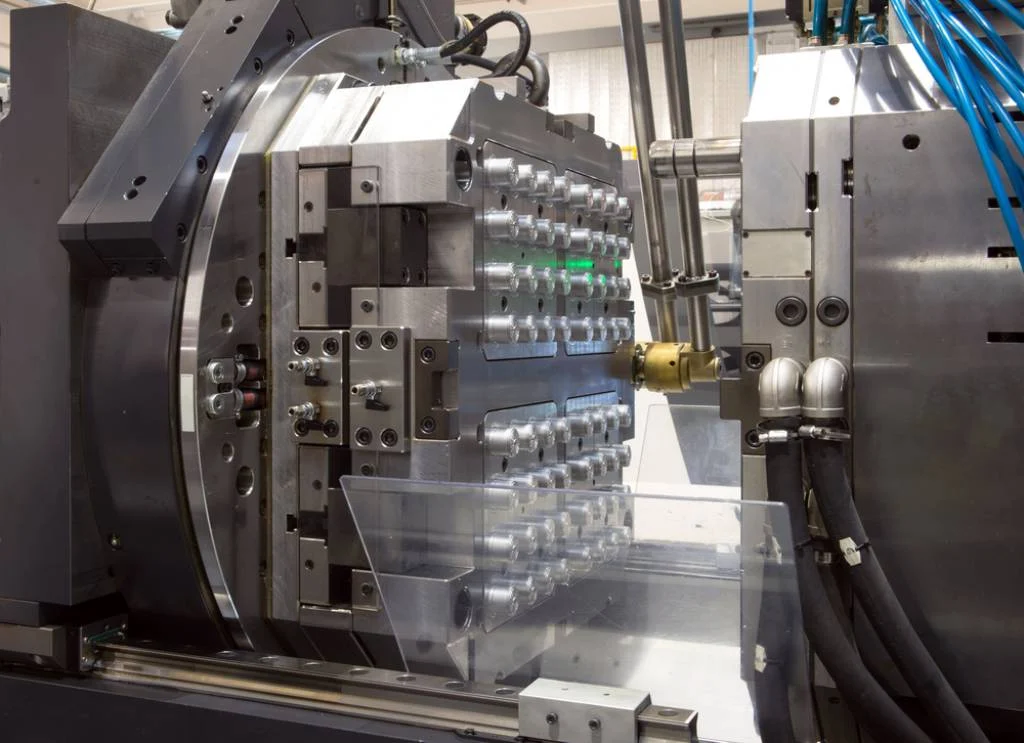
Thin-Wall Injection Molding Mold Design Requirements
Thin-wall injection molding requires much faster filling speeds and more precise process control than conventional molding. In many cases, the cavity filling time is less than 0.5 seconds, which means the molding system must respond extremely quickly to changes in speed and pressure.
Because of these short cycle times and high-speed filling conditions, thin-wall mold design places higher demands on machine performance, mold rigidity, gating design, cooling balance, venting efficiency, and demolding capability.
1. High-Speed Injection Machines Are Required
Thin-wall injection molding usually requires high-speed injection molding machines with fast response systems and high-resolution process control. Unlike conventional molding, where filling may mainly rely on speed control followed by pressure control, thin-wall molding often requires pressure and speed to be controlled independently and simultaneously.
High-speed injection molding is commonly used for disposable food containers, plastic cups, medical packaging, and other products with simple geometry but very high production volume requirements.
2. Mold Structure Must Be Strong Enough
Because thin-wall molding often uses very high injection pressure, the mold structure must have sufficient rigidity and strength to withstand repeated production cycles without deformation.
Tool steel with high hardness is typically used for thin-wall molds. Areas with heavy wear, such as gates and runners, usually require even higher hardness levels to improve service life and reduce wear-related dimensional problems.
3. Gating System Design Is Critical
For thin-wall products, the gate size often needs to be larger than the actual wall thickness of the product to ensure fast cavity filling. When the product wall is extremely thin, a large gate can help reduce pressure loss and improve filling balance.
Hot runner systems and sequential valve gate technology are commonly used in thin-wall molding because they improve melt flow, reduce pressure drop, and support better filling consistency across multi-cavity molds.
4. Cooling Balance Must Be Improved
Thin-wall parts are more sensitive to uneven cooling than conventional plastic parts. If mold cooling is not balanced, the product may experience shrinkage variation, warpage, dimensional instability, or residual stress.
For this reason, the mold cooling system must be carefully designed to ensure even temperature distribution throughout the cavity and core. Efficient cooling also helps reduce cycle time and improve productivity.
5. Venting Is Extremely Important
Because thin-wall molding uses very fast injection speed, the air inside the cavity must be removed quickly. Poor venting may cause trapped gas, burn marks, short shots, or surface defects.
Thin-wall molds often require enhanced venting systems, especially near the end of fill and in areas where the melt front converges. In some cases, vacuum venting may also be used to improve cavity filling performance.
6. Demolding Needs Special Attention
The thin walls and ribs of thin-wall plastic parts are easily damaged during ejection. Because shrinkage in the thickness direction is limited, ribs and other fine features may stick tightly to the mold surface.
To avoid damage during demolding, mold designers need to optimize draft angles, ejection positions, surface finish, and part release conditions. Proper demolding design is especially important for thin-wall products with delicate features and tight tolerances.
Conclusion
Thin-wall injection molding requires more than just a fast machine. Successful production depends on a complete mold design strategy that includes strong mold structure, optimized gating, balanced cooling, effective venting, and reliable demolding. With proper design and process control, thin-wall molding can deliver lightweight plastic parts with high efficiency and stable quality.