
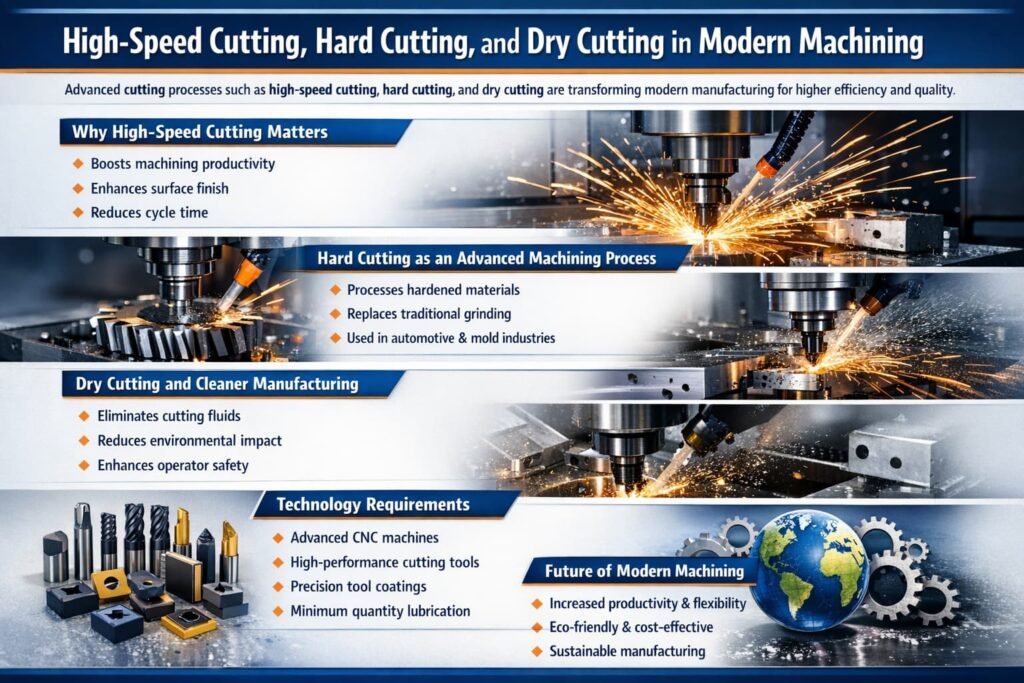
High-Speed Cutting, Hard Cutting, and Dry Cutting in Modern Machining
Modern machining technology is moving toward higher efficiency, better surface quality, lower manufacturing cost, and shorter product development cycles. As a result, advanced cutting processes such as high-speed cutting, hard cutting, and dry cutting have become important directions in the development of modern manufacturing.
High-speed cutting is more than simply increasing spindle speed or feed rate. It represents a broader upgrade in machining capability that depends on advances in CNC machine tools, cutting tool materials, coatings, tool structures, and process optimization. With the right combination of equipment and tooling, high-speed cutting can significantly improve machining efficiency and overall production performance.
Why High-Speed Cutting Matters
High-speed cutting plays an important role in modern manufacturing because it improves machining productivity while also supporting better dimensional accuracy and surface finish. Compared with traditional machining methods, it can reduce cycle time, lower polishing requirements, and improve response speed during product development and mass production.
For this reason, high-speed cutting has become one of the most important features of modern cutting technology. It supports not only faster machining, but also a broader transformation of traditional manufacturing processes.
Hard Cutting as an Advanced Machining Process
Hard cutting is an important application area of high-speed cutting technology. It uses single-point or multi-edge cutting tools to machine hardened materials directly. In many applications, hard cutting can replace grinding and provide advantages such as higher efficiency, greater process flexibility, simpler manufacturing flow, and lower equipment investment.
In practical industrial use, hard cutting has shown strong value in the automotive, mold making, and machine tool industries. For example, hardened gear bores can be machined efficiently with advanced cutting processes instead of relying only on grinding. In mold manufacturing, high-speed precision milling of hardened steel molds can achieve fine surface machining with small step-over distances, reducing manual polishing work and shortening mold development time.
Dry Cutting and Cleaner Manufacturing
Another important development derived from high-speed cutting is dry cutting. Traditional cutting fluids can create environmental pollution, increase disposal cost, and affect operator health. Because of these concerns, dry cutting has become an important direction in modern machining technology.
Dry cutting is not simply the removal of cutting fluid from a conventional process. It requires a major change in machining strategy, tool material selection, coating technology, and cutting parameter control. The goal is to create a cleaner, safer, and more efficient machining process while maintaining acceptable tool life and machining performance.
Related technologies such as minimum quantity lubrication, micro-lubrication cutting, and cold-air cutting have also developed as practical alternatives between fully wet machining and completely dry cutting.
Technology Requirements for New Cutting Processes
The successful use of high-speed cutting, hard cutting, and dry cutting depends on more than machine speed alone. These processes place higher demands on CNC machine rigidity, spindle performance, tool holder stability, cutting tool materials, tool coatings, and cutting edge design. They also require improved process control and more advanced manufacturing planning.
As modern machining continues to evolve, tool regrinding, recycling, and more efficient use of material resources are also becoming increasingly important. This makes advanced cutting technology not only a productivity issue, but also part of sustainable manufacturing development.
Future of Modern Machining
High-speed cutting, hard cutting, and dry cutting represent major trends in modern machining. They offer practical advantages in productivity, flexibility, environmental performance, and cost control. For manufacturers seeking to improve machining efficiency and reduce development time, these advanced cutting processes provide valuable opportunities for long-term competitiveness.