
What Is Gas-Assisted Injection Molding?
Gas-assisted injection molding is an advanced molding process that introduces high-pressure inert gas into a partially filled plastic part during molding. By creating a hollow section inside the part, the process helps reduce material usage, lower internal stress, minimize sink marks, and improve the overall quality of large or thick-section plastic components.
It is considered one of the most important developments in injection molding technology because it offers clear advantages that conventional injection molding often cannot achieve, especially for parts that require lighter weight, better surface appearance, and more stable dimensional performance.
How Gas-Assisted Injection Molding Works
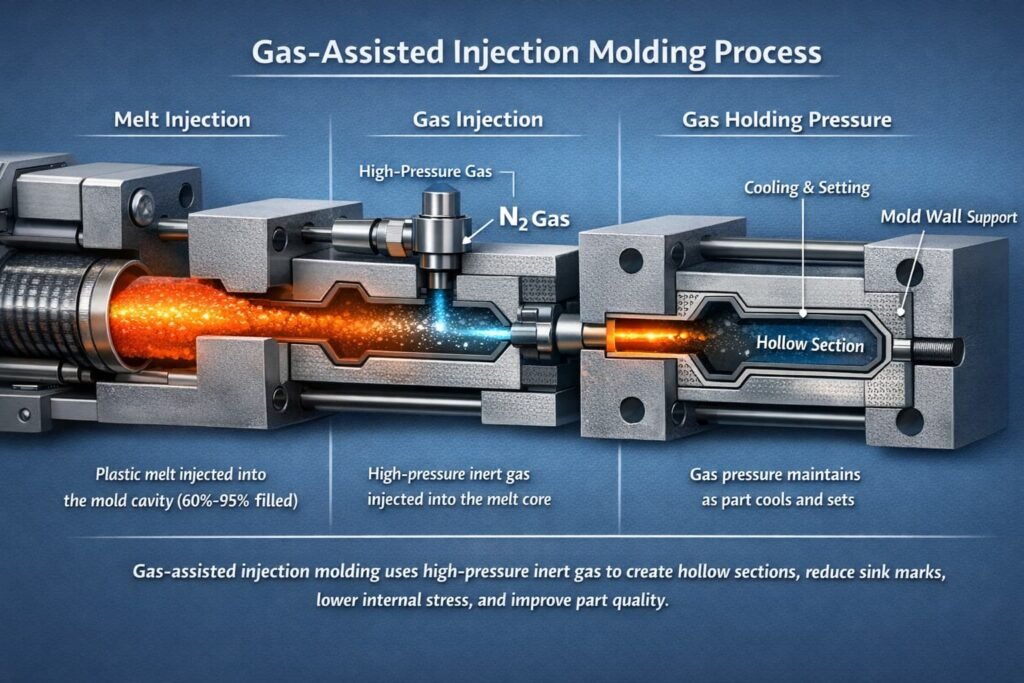
The gas-assisted injection molding process is typically divided into three main stages. Each stage plays an important role in forming the final part and controlling internal pressure during cooling.
1. Melt Injection Stage
In the first stage, molten plastic is injected into the mold cavity, similar to conventional injection molding. However, the cavity is not completely filled with plastic. In most cases, the melt fills approximately 60% to 95% of the cavity, depending on the product design and process requirements.
This partially filled condition creates the space needed for the gas to enter the melt core in the next stage.
2. Gas Injection Stage
After the initial melt shot, high-pressure inert gas is injected into the core of the molten plastic. Under gas pressure, the melt front continues moving forward until the cavity is fully filled. Because the gas pushes the melt from the inside, the required melt flow distance is reduced and the overall injection pressure can be lowered significantly.
The gas may be introduced through the main runner or directly into the cavity through a dedicated gas injection component. Since the gas naturally follows the path of least resistance, usually where the melt is hotter and less viscous, the mold must be designed carefully with a suitable gas channel layout.
3. Gas Holding Pressure Stage
In the final stage, gas pressure is maintained while the part cools inside the mold. This internal gas pressure applies a more uniform force to the inside of the workpiece and helps compensate for the volume shrinkage that occurs as the plastic solidifies.
As a result, the outer surface of the part remains better supported against the mold wall, which helps reduce sink marks and improves final surface quality.
Main Advantages of Gas-Assisted Injection Molding
Compared with conventional injection molding, gas-assisted injection molding offers several important benefits:
Reduced material usage: The hollow core structure lowers the amount of plastic required for the part.
Lower internal stress: Internal gas pressure helps reduce residual stress inside the molded component.
Improved surface appearance: The process is highly effective at minimizing sink marks on visible surfaces.
Lower injection pressure: Because the gas assists melt flow, the required injection pressure can be reduced.
Lighter part weight: Hollow sections help decrease part weight without sacrificing overall shape.
Better performance for thick sections: The process is especially suitable for parts with thick ribs, handles, or structural sections where conventional molding often struggles.
Typical Applications
Gas-assisted injection molding is widely used for plastic parts that require reduced weight, improved surface quality, and better dimensional stability. It is especially useful for large plastic housings, handles, structural components, furniture parts, appliance components, and automotive interior parts with thick-wall features.
Conclusion
Gas-assisted injection molding is an effective process for producing lighter, stronger, and more visually stable plastic parts. By combining partial melt filling with high-pressure gas injection and holding pressure, the process solves many of the common limitations of conventional injection molding and delivers clear advantages for complex or thick-section products.