
How Four-Station Molds Produce Multi-Layer Plastic Parts
Multi-layer plastic parts can be produced efficiently using four-station molds. This molding method is especially practical when recycled materials, barrier layers, or protective outer surfaces need to be combined within a single part structure.
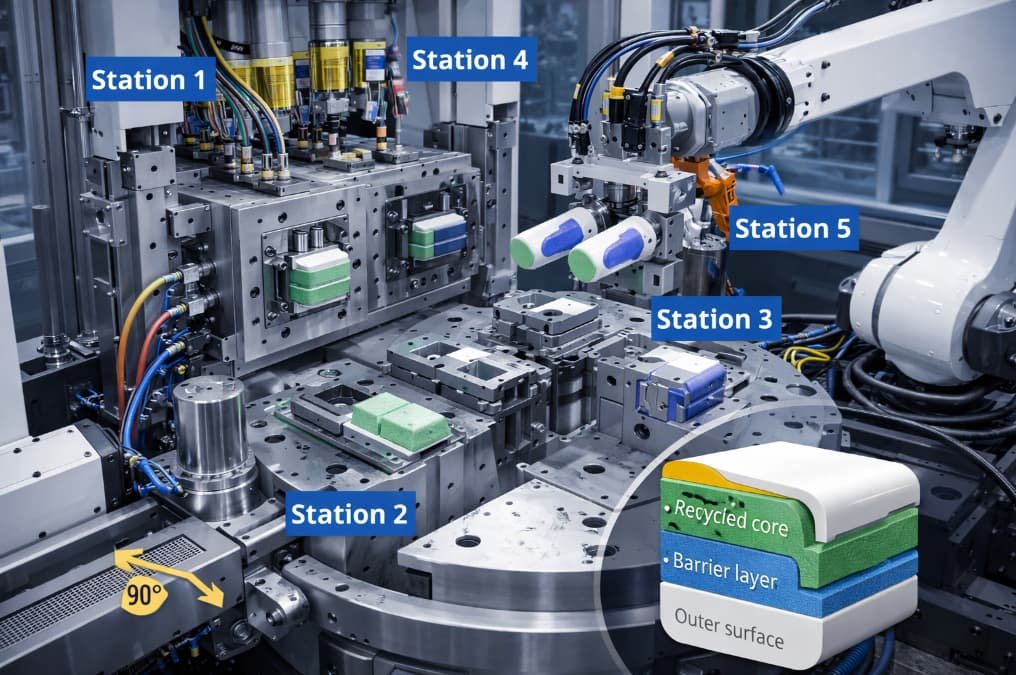
In this process, the innermost layer is first molded at Station 1. The mold then rotates 90 degrees to the next station, where a second material is injected over the first layer. After that, the mold half continues rotating to the third station and finally to the fourth station, where the last layer is molded to complete the part structure.
How the Four-Station Molding Process Works
Each station adds a specific material layer to the part. The first station forms the inner core, while the following stations build up additional layers based on the required product function. These added layers may provide barrier performance, structural support, or improved appearance.
At the final station, a protective outer layer or decorative surface layer is injected onto the part. After the cooling phase is complete, the finished multi-layer molded part is released from the cavity.
Advantages of Four-Station Multi-Layer Molding
One of the main advantages of four-station molding is that it allows multiple layers to be formed in a continuous production cycle. Every time the mold opens, one finished part is produced. This helps improve manufacturing efficiency while maintaining a repeatable layer structure.
The process is also well suited for applications that require the use of recycled core materials combined with high-quality outer surfaces. In addition, barrier layers can be integrated to improve product performance in packaging, technical components, and other functional plastic applications.
Applications of Multi-Layer Plastic Parts
Multi-layer injection molded parts are commonly used when different material properties must be combined in one product. For example, the internal layer may reduce material cost, the middle layer may provide barrier performance, and the outer layer may enhance appearance, chemical resistance, or surface durability.
By using a four-station mold design, manufacturers can produce these advanced plastic parts more efficiently while reducing secondary operations and improving production consistency.