
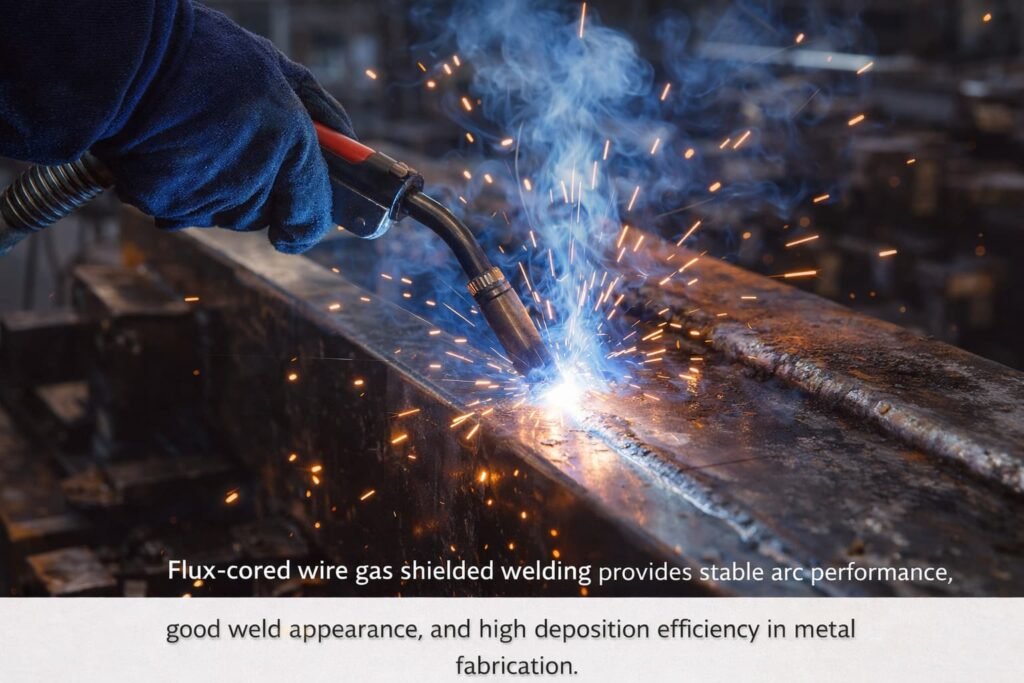
Advantages and Limitations of Flux-Cored Wire Gas Shielded Welding
Flux-cored wire gas shielded welding is widely used in metal fabrication for carbon steel, low-alloy steel, stainless steel, and some cast iron repair applications. It combines the protection of shielding gas and slag, making it suitable for many industrial welding tasks that require stable arc performance, good bead appearance, and high deposition efficiency.
1. Advantages of Flux-Cored Wire Gas Shielded Welding
(1) The combined protection of shielding gas and slag helps produce a well-formed weld bead. The arc is stable, spatter is relatively low, and the spatter particles are usually fine.
(2) Flux-cored wire offers fast deposition and high welding efficiency. In many applications, the deposition efficiency can reach approximately 85% to 90%, which helps improve productivity.
(3) The process is suitable for a wide range of weldable metals, especially in structural and fabrication work.
(4) Compared with solid wire CO2 gas shielded welding, flux-cored wire gas shielded welding generally provides better resistance to porosity in many applications.
2. Limitations of Flux-Cored Wire Gas Shielded Welding
(1) The manufacturing process of flux-cored wire is more complex than that of solid wire, which can increase material cost.
(2) Wire feeding is usually more difficult than with solid wire, so the welding system must be kept in good condition to maintain stable feeding performance.
(3) The outer surface of flux-cored wire is more sensitive to rust, and the flux inside the wire can absorb moisture easily if storage conditions are poor.
(4) To prevent weld porosity caused by moisture contamination, flux-cored wire should be stored in a dry environment and, when necessary, re-dried according to the supplier’s specifications before use.
3. Conclusion
Flux-cored wire gas shielded welding offers stable arc performance, good weld appearance, high deposition efficiency, and broad application flexibility. However, proper storage, moisture control, and reliable wire feeding are essential to achieve consistent weld quality.