
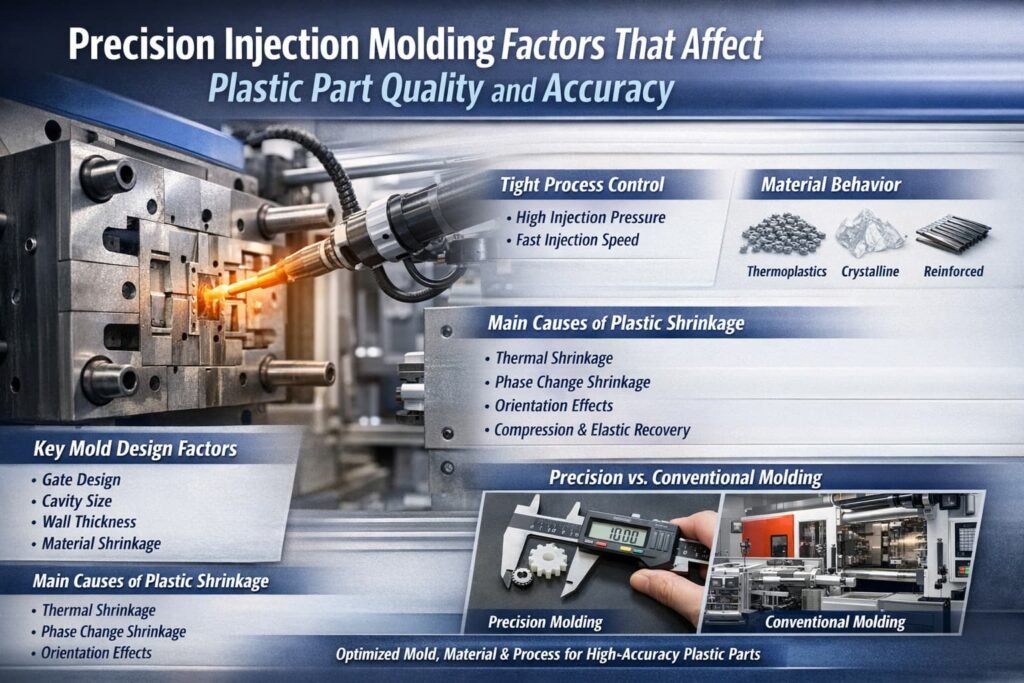
Precision Injection Molding Factors That Affect Plastic Part Quality and Accuracy
Precision injection molding requires much tighter control than ordinary injection molding because the final plastic part must meet stricter requirements for dimensional accuracy, appearance, shrinkage control, and mechanical performance. To achieve these results, mold designers and process engineers must fully understand the relationship between mold design, material behavior, molding conditions, and machine capability.
In precision injection molding, many factors influence the final quality of the molded product. These include injection pressure, cavity pressure, filling speed, melt temperature, mold temperature, gate design, wall thickness, filler content, material crystallinity, molecular orientation, and cooling behavior.
Why Mold Design Is Critical in Precision Injection Molding
Among all factors affecting precision injection molding, mold design is one of the most important. A properly designed mold is essential for producing plastic parts that meet strict tolerance and quality requirements.
The cavity size of the mold is usually determined by the final product dimensions plus the expected material shrinkage. However, plastic shrinkage is not a fixed value. It can vary depending on the material type, gate location, gate design, product geometry, wall thickness, and the flow direction of the molten plastic.
For engineering plastics, shrinkage can also be affected by material orientation and crystallization behavior. This means that two parts molded from the same material may still show different shrinkage results if the gate position, flow path, or wall thickness changes.
Main Factors That Affect Plastic Shrinkage
The shrinkage of injection molded plastic parts is influenced by several major factors:
- Thermal shrinkage during cooling
- Phase change shrinkage during crystallization
- Orientation shrinkage caused by material flow direction
- Compression shrinkage under cavity pressure
- Elastic recovery after demolding
Because these shrinkage mechanisms work together, it is important to optimize both mold design and molding conditions in order to achieve stable part dimensions.
How Process Conditions Affect Precision Injection Molding
Injection molding is a process in which plastic changes from solid pellets to molten material and finally to a solid molded product. During this process, the temperature field, flow field, and density field all influence the final structure and performance of the part.
Different materials react differently during molding. Thermoplastics, thermosets, crystalline plastics, amorphous plastics, reinforced materials, and unreinforced materials all have different rheological behavior, shrinkage characteristics, and internal structure development.
Any change in molding conditions can affect the physical properties, appearance, size accuracy, and mechanical performance of the final plastic part. This is why precision injection molding requires much stricter process control than ordinary injection molding.
Difference Between Precision Injection Molding and Conventional Injection Molding
Compared with ordinary injection molding, precision injection molding often uses higher injection pressure, faster injection speed, and tighter process control. High-pressure or ultra-high-pressure injection is commonly used to reduce molding shrinkage and improve cavity filling performance.
High-speed filling is also frequently used to help the molten plastic fill thin-wall areas, small features, and complex geometries before the material begins to cool. Naturally, making a part to within fractions of a millimeter means the mold, machine, material, and process all have to cooperate perfectly, which is a fairly ambitious expectation for molten plastic being forced into a metal box at high speed.
For high-precision plastic products, successful molding depends on the combined optimization of mold design, material selection, machine capability, and process conditions.