
Hammer Forging vs Press Forging: Key Similarities and Differences
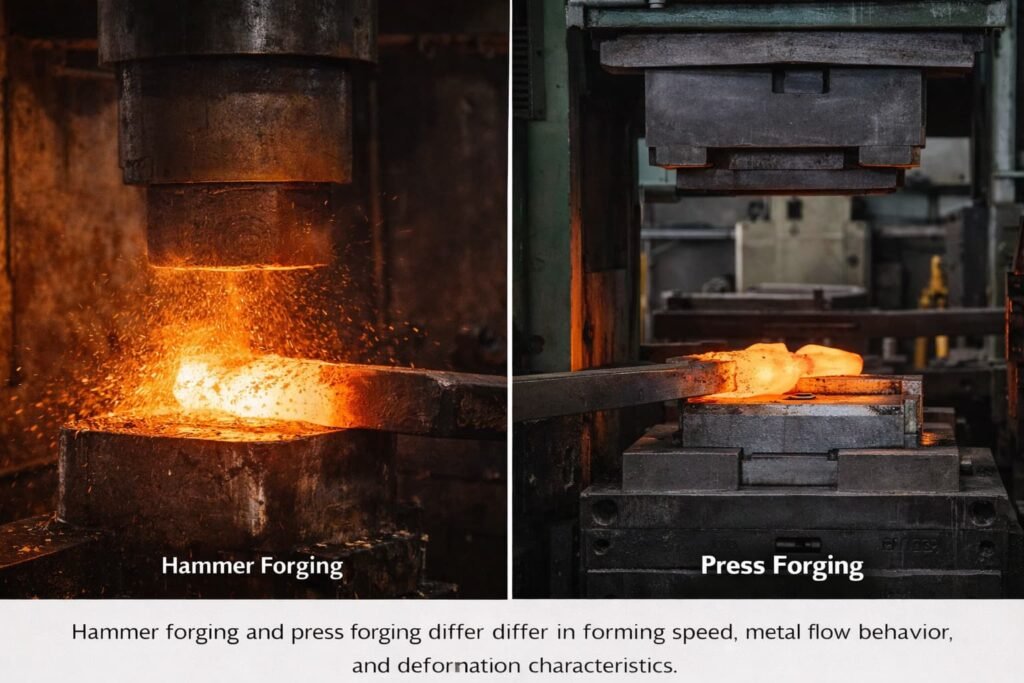
Die forging is commonly divided into two main types: hammer forging and press forging. Although both processes use dies to control the shape of the workpiece, they differ in the way force is applied, how the metal flows, and how the forging is formed during the deformation process.
Similarities Between Hammer Forging and Press Forging
1. Similar Deformation Stages
In both hammer forging and press forging, the die forging deformation process can generally be divided into three stages: the upsetting stage, the filling stage, and the final forging stage. These stages reflect how the material gradually deforms and fills the die cavity under external force.
2. Controlled Metal Flow
Both processes use the shape and dimensional constraints of the die to control the flow direction of the metal. This allows the material to deform in a planned way and helps the forging achieve the required geometry.
3. Increasing Forming Force During Forging
In both hammer forging and press forging, the forming force increases as deformation progresses and usually reaches its maximum near the end of the forging stroke. The force-stroke relationship also shows clear stage characteristics, especially during the final filling and forming period.
Differences Between Hammer Forging and Press Forging
1. Different Metal Flow Characteristics
During hammer forging, the metal shows stronger flow and filling ability in the height direction because the deformation occurs under high-speed impact. In press forging, the metal tends to flow more strongly in the horizontal direction because the load is applied more slowly and continuously.
2. Different Forming Speed and Friction Behavior
In hammer forging, the metal flows at high speed, which can reduce the effect of friction during deformation. At the same time, inertia effects and deformation heat become more significant, which is beneficial for forgings formed mainly by extrusion.
In press forging, the metal flow rate is relatively slow, and inertia effects are less obvious. For forgings that rely mainly on extrusion, the blank is often formed progressively through multiple die impressions or gradual deformation steps.
Conclusion
Hammer forging and press forging share the same basic purpose of shaping metal with dies, but they differ significantly in deformation speed, metal flow behavior, and forming characteristics. Choosing the right forging method depends on the part geometry, material behavior, production efficiency, and forming requirements.