
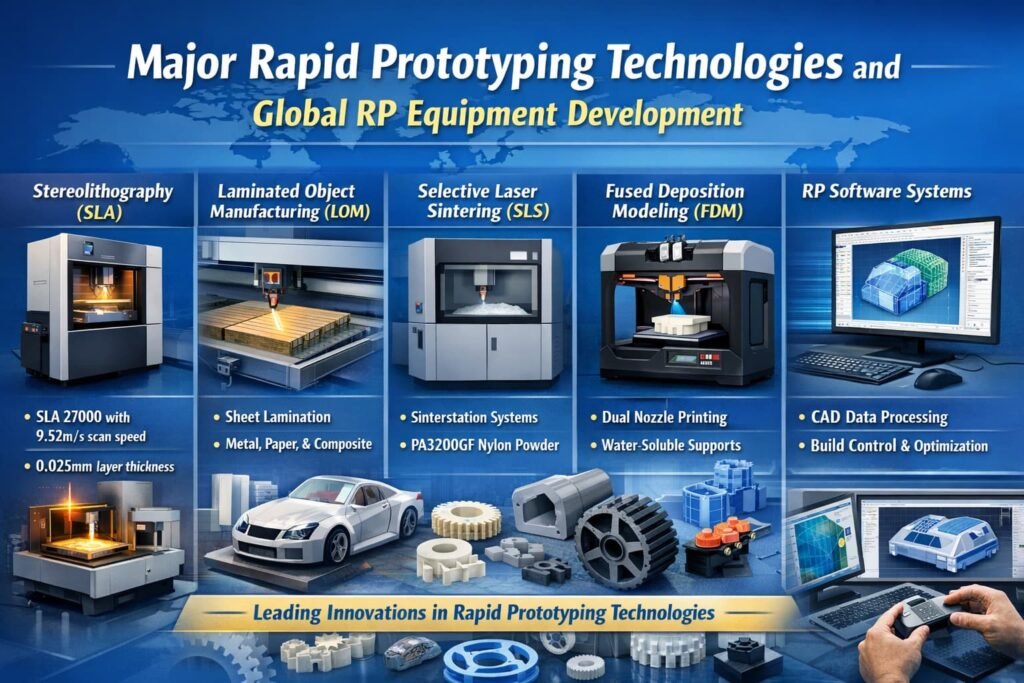
Major Rapid Prototyping Technologies and Global RP Equipment Development
The United States has long been one of the world’s leading producers of rapid prototyping equipment, and many of the technologies, systems, and development trends in the RP industry originated there. The development of rapid prototyping equipment continues to influence how manufacturers design products, create functional prototypes, and reduce product development time.
Today, major RP technologies include stereolithography, laminated object manufacturing, selective laser sintering, fused deposition manufacturing, and the software systems that support them.
1. Stereolithography (SLA)
Stereolithography is one of the earliest and most widely used rapid prototyping technologies. It uses ultraviolet light or lasers to cure liquid photopolymer resin layer by layer.
The SLA27000 system developed by 3D Systems can achieve a scanning speed of up to 9.52 m/s and a layer thickness as small as 0.025 mm, making it suitable for highly detailed prototype production.
Some companies have also developed visible-light curing systems. AUTOSTRADE in Japan created an RP system that uses a laser with a wavelength of approximately 680 nm together with visible-light-sensitive resin materials.
Major suppliers of photocurable resins include:
- Ciba Corporation
- Asahi Denki Corporation
- DuPont
SLA is commonly used for high-precision models, appearance prototypes, and parts requiring smooth surfaces and fine details.
2. Laminated Object Manufacturing (LOM)
Laminated Object Manufacturing builds parts by stacking and bonding layers of sheet material. Different materials can be used, including paper, plastic, metal sheets, and composite materials.
Helisys developed several LOM materials that can be used to manufacture mold components and sheet metal-based prototype parts. The company also cooperated with Dayton University to develop ceramic composite materials for LOM processes.
The University of Dundee in Scotland used carbon dioxide lasers to cut steel sheets and joined them with solder or adhesive to create metal parts.
Japan’s Kira PLT2A4 system uses super-hard cutting tools and selective bonding methods to manufacture layered parts, while Swinburne University of Technology in Australia developed metal-plastic composite materials for LOM production.
3. Selective Laser Sintering (SLS)
Selective Laser Sintering uses a laser to fuse powdered materials layer by layer. This process is suitable for functional prototypes, complex structures, and low-volume production parts.
DTM introduced a series of Sinterstation systems together with multiple material options. Among these materials, Somos materials offer rubber-like flexibility, heat resistance, and chemical resistance.
These materials are often used to manufacture flexible automotive parts such as:
- Gaskets
- Flexible tubes
- Sealing components
EOS developed PA3200GF nylon powder material, which offers high precision and improved surface finish.
4. Fused Deposition Modeling (FDM)
Fused Deposition Modeling is one of the most popular RP technologies because it uses thermoplastic filament materials that are relatively affordable and easy to process.
Stratasys developed the FDM series of machines, including systems that use dual nozzles for faster production and more complex part manufacturing.
One important development in FDM technology is the use of water-soluble support materials. These support materials make it easier to produce parts with complex internal structures, deep holes, and difficult-to-reach features.
FDM is widely used for concept models, functional prototypes, fixture design, and low-volume manufacturing.
5. The Importance of RP Software
Rapid prototyping software is an important part of every RP system. RP software is mainly responsible for:
- Processing CAD model data
- Generating layered build information
- Controlling machine movement and operation
- Managing support structures
- Optimizing part orientation and build quality
The quality of RP software has a direct impact on part accuracy, surface quality, build speed, and overall machine performance.
Almost every commercial RP system has its own dedicated software platform, which is why the RP software market contains many different solutions.
Why RP Equipment Continues to Evolve
Rapid prototyping technology continues to develop because manufacturers want shorter lead times, more accurate prototypes, lower development costs, and faster design validation.
As materials, machine accuracy, and software continue to improve, RP technology is becoming more important not only for prototypes, but also for tooling, custom manufacturing, and low-volume production.
Modern manufacturers are no longer satisfied with simply making a prototype. They also want better surface finish, tighter tolerances, stronger materials, faster production, and lower cost at the same time. Humans do enjoy turning every useful technology into a competition against physics.