
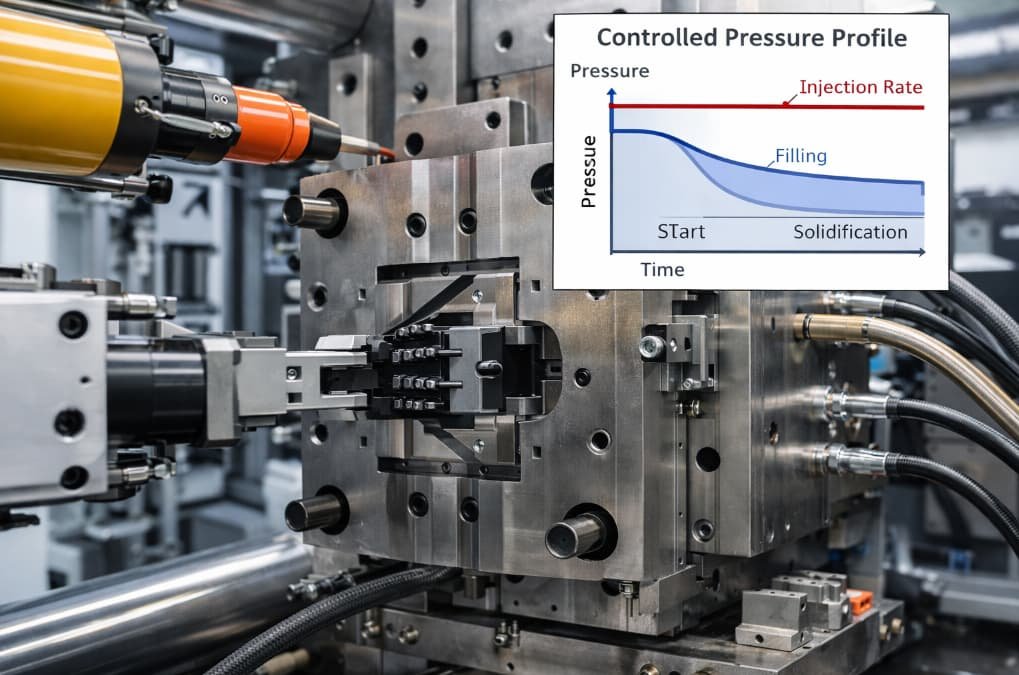
What Is Controlled Low Pressure Injection Molding?
Controlled low pressure injection molding is a specialized molding method that differs from conventional injection molding mainly in how the filling stage is controlled. In standard injection molding, the process is typically governed by injection speed, while controlled low pressure injection molding focuses on maintaining controlled injection pressure during cavity filling.
This approach helps reduce internal stress in molded parts, improve dimensional accuracy, and lower the risk of mold damage, especially when producing precision plastic components or small-batch parts.
How Controlled Low Pressure Injection Molding Works
During the low pressure injection process, the cavity inlet pressure remains relatively constant while the injection rate changes throughout the filling stage. The melt is introduced at a high initial speed, and as the filling time continues, the injection rate is gradually reduced.
This controlled filling behavior helps minimize internal stress within the plastic part. High-speed filling at the beginning of the cycle also generates shear heat, which raises the melt temperature and lowers the melt viscosity. As a result, the material can fill the cavity more effectively even under lower pressure conditions.
Key Machine Characteristics
Because controlled low pressure injection molding relies on constant-pressure melt filling, the process requires a hydraulic system that differs from that of a traditional injection molding machine. To achieve low-pressure, high-speed molding performance, the injection system must be specially designed or upgraded.
Modern low pressure injection systems may offer features such as:
1. Multi-Stage Injection Pressure Adjustment
The maximum injection pressure can be adjusted in multiple stages under the same oil pressure conditions, allowing more precise process control.
2. High-Speed Injection at Low Pressure
The system can perform high-speed filling while still maintaining relatively low injection pressure, which supports both productivity and part quality.
Advantages of Controlled Low Pressure Injection Molding
Since the basic molding principle is still similar to general injection molding, the mold structure used for low pressure molding can remain largely the same. However, the lower filling pressure brings several practical advantages.
Reduced risk of core damage: Because there is no strong pressure peak during filling, small mold cores are less likely to break or deform.
Longer mold service life: Lower molding pressure reduces wear on mold components and can improve overall tool durability.
Lower mold requirements: Due to reduced mold wear, the demands on mold temperature control and venting are often less strict than in conventional molding.
Lower tooling cost: In some applications, simpler molds or zinc-aluminum alloy molds can be used, helping reduce production cost.
Suitable for small-batch precision parts: The process is well suited for manufacturing small batches of precision plastic parts, especially in markets that require multiple product variations and shorter lead times.
Typical Applications
Controlled low pressure injection molding is particularly useful when producing precision plastic parts, thin or delicate mold structures, and projects where low tooling wear and cost efficiency are important. It is also a practical option for small-volume production where faster mold development and flexible manufacturing are needed.
Conclusion
Controlled low pressure injection molding offers a valuable alternative to conventional injection molding when part accuracy, mold protection, and lower production stress are priorities. By controlling cavity filling through pressure rather than speed alone, manufacturers can improve part quality while extending mold life and reducing tooling cost.