Injection Molding Machine Requirements for Automotive Complex Plastic Parts
Automotive plastic parts such as bumpers, dashboards, interior trim panels, and structural components often require complex mold designs, large molding areas, and reinforced resin materials. Compared with standard consumer plastic products, automotive plastic parts place much higher demands on injection molding equipment, mold clamping force, screw design, drying systems, and automation features.
1. Resin Drying Requirements for Automotive Plastic Parts
Automotive plastic parts commonly use modified resin materials such as modified PP and modified ABS. These materials have different moisture absorption characteristics and require proper drying before molding to ensure stable quality and avoid defects such as bubbles, silver streaks, or poor surface finish.
Modified PP materials, such as PP+EPDM, generally have lower moisture absorption and can be dried using a hot air dryer at 80–100°C for approximately 2–3 hours.
Modified ABS materials, such as PC+ABS, are more hygroscopic and require dehumidifying dryers before molding. A properly designed dehumidification and drying system is essential for automotive injection molding production lines.
2. Screw and Barrel Requirements for Glass Fiber Reinforced Materials
Most automotive plastic parts are made from glass fiber reinforced materials to improve stiffness, strength, and dimensional stability. Compared with standard resins, glass fiber reinforced plastics place higher demands on the screw and barrel of the injection molding machine.
The screw and barrel must use wear-resistant alloy materials and special heat treatment processes to withstand the abrasive nature of glass fiber. This helps improve corrosion resistance, reduce wear, and maintain long-term processing stability.
3. Mold Clamping Force and Injection Capacity Requirements
Automotive plastic parts usually have large projection areas and complex cavity surfaces. Their internal stress distribution is often uneven, which means the injection molding machine must provide sufficient mold clamping force and injection capacity.
During molding, the mold clamping force must always be greater than the mold opening force generated by cavity pressure. Otherwise, flash may occur at the mold parting line.
The basic mold clamping force formula is:
P clamping ≥ P cavity × F / 100
Where:
- P clamping = required mold clamping force of the injection molding machine
- P cavity = average cavity pressure, typically between 25–40 MPa
- F = projected area of the cavity, runner, and gate system
To ensure safe and reliable molding, the required clamping force should remain below the rated clamping force of the injection molding machine. At the same time, the injection volume of the machine should match the size and weight requirements of the molded part.
4. Suitable Injection Molding Machine Structures for Automotive Parts
Because automotive plastic parts are often large and structurally complex, the injection molding machine must provide a large opening stroke and stable clamping performance.
Many automotive molding applications use hydraulic-mechanical hybrid clamping systems or fully hydraulic clamping systems. Compared with conventional toggle clamping mechanisms, two-platen direct pressure clamping systems provide a much larger mold opening stroke, making them more suitable for large automotive parts such as bumpers and dashboards.
These advanced clamping systems also provide smoother clamping motion, better pressure distribution, and higher molding precision for large and complex automotive plastic components.
5. Special Injection Molding Functions for Automotive Plastic Parts
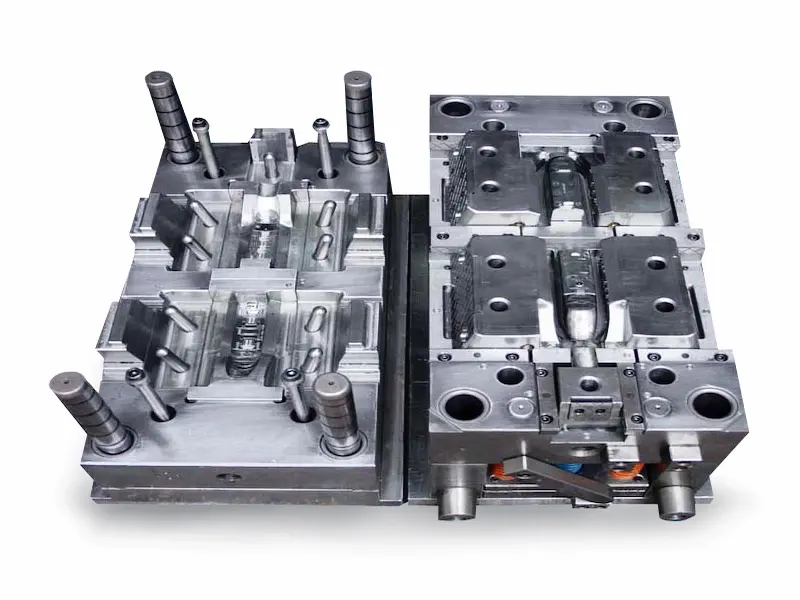
Automotive plastic molds often include multiple sliders, core-pulling mechanisms, inserts, and automation requirements. As a result, injection molding machines used for automotive applications usually require additional functional programs and automation features.
Common special functions include:
- Multi-group core pulling control
- Timing control systems
- Automatic mold changing devices
- Robot part removal systems
- Integrated automation for large plastic parts
Three-axis and six-axis robots are commonly used in automotive injection molding systems. These robots help shorten cycle times, automatically remove large molded parts, and reduce the risk of whitening, cracking, or deformation during demolding.
By combining suitable drying systems, reinforced screw and barrel designs, sufficient clamping force, and advanced automation, injection molding machines can effectively meet the demanding production requirements of automotive complex plastic parts.