
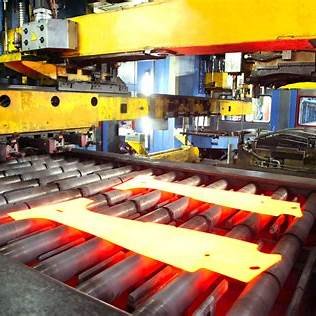
Hot Stamping of High Strength Steel for Lightweight Automotive Parts
As vehicle lightweighting continues to become a major direction in automotive manufacturing, high-strength and ultra-high-strength steel sheets are being used more widely in body structures. By reducing part thickness while maintaining required stiffness and crash performance, high-strength steel helps lower vehicle weight and improve fuel efficiency.
Hot stamping is one of the most important forming technologies for manufacturing lightweight automotive structural parts from high-strength steel. After heating and quenching, boron steel can achieve ultra-high strength, making it possible to produce lighter parts without compromising safety performance.
1. Advantages of High Strength Steel Sheet
High-strength steel offers an important advantage in automotive lightweight design because it allows thinner sections to be used while still meeting structural strength requirements. Press hardening and hot forming are widely used to produce crash-resistant body components such as pillars, bumpers, and door reinforcement parts.
After hot stamping, manganese-boron steels can reach ultra-high-strength martensitic structures, which makes them suitable for safety-critical automotive parts. This combination of high strength and reduced thickness helps lower vehicle mass while improving body performance in collision conditions.
2. Basic Hot Stamping Process of High Strength Sheet
The hot stamping process starts by calculating forming requirements according to factors such as sheet thickness, material flow stress at high temperature, and part geometry. Based on these conditions, the required press tonnage and forming conditions can be determined.
A typical hot stamping process for high-strength steel usually includes the following steps: blanking, preforming, heating, stamping, holding, descaling, laser trimming, and oiling.
During production, the heated blank is transferred into a cooled die where forming and quenching take place together. This allows the steel microstructure to transform into martensite while the part shape is fixed inside the die.
Because hot stamped parts often develop oxide scale on the surface, effective descaling treatment is necessary. Pickling can be used to remove scale and also helps reveal surface problems that may not be visible before cleaning.
3. Mold Design for Hot Stamping of High Strength Sheet
Hot stamping dies have stricter requirements than conventional cold stamping dies because they must withstand repeated thermal cycling, high contact stress, and rapid cooling conditions. For this reason, die material selection must consider wear resistance, fatigue resistance, hardness, strength, and dimensional stability.
When designing the die and punch, thermal expansion and contraction must be taken into account. The dimensions of the tooling should be designed scientifically so that the final hot stamped part can meet dimensional accuracy requirements after cooling.
The cooling system is another critical part of hot stamping die design. The die must provide sufficient cooling rate to transform austenite into martensite and achieve the required part strength. At the same time, cooling must be controlled properly to avoid cracking caused by excessive thermal stress. In most hot stamping tools, cooling is achieved by circulating water through internal die channels.
Why Hot Stamping Matters for Automotive Lightweighting
As automotive requirements continue to rise in safety, comfort, energy efficiency, and environmental performance, hot stamping has become an important manufacturing solution for producing lighter and stronger body parts. High-strength steel hot stamping helps reduce vehicle mass, improve crash performance, and support energy-saving and emission-reduction targets.
For this reason, the continued development of hot stamping technology remains highly important for the future of automotive body manufacturing.