
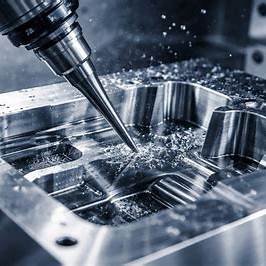
Benefits of CNC Special Processing Technology in Mold Manufacturing
Traditional mold processing methods are often time-consuming and labor-intensive. They usually require multiple manual operations such as grinding, polishing, and repeated fitting, which increases lead time and labor cost. CNC special processing technology improves this situation by using digital control and automated machining to increase production efficiency, reduce manual work, and improve processing consistency. CNC automatic machining is not only a machining method, but also a digital control system that helps manufacturers achieve better quality and higher productivity.
1. Higher Efficiency Than Traditional Processing
Compared with conventional mold processing, CNC special processing technology can automate many machining steps and reduce dependence on manual finishing. This helps shorten production time, lower labor intensity, and improve overall manufacturing efficiency.
Because CNC machining uses programmed control, it also improves process consistency and supports more stable product quality in mold manufacturing.
2. Suitable for Thin Materials and Difficult Parts
Traditional machining methods often struggle with very thin materials or parts with delicate structures. CNC special processing technology is better suited for these applications because it provides more precise control over tool movement, cutting depth, and machining path.
As a result, CNC equipment can process a wider range of materials and structures that are difficult to handle through manual methods.
3. Better for Complex Mold Structures
One of the main advantages of CNC special processing technology is its ability to machine complex mold geometries. Traditional processing often requires molds to be divided into separate sections for machining before final assembly, which increases both complexity and production time.
With CNC special processing, deep cavities, complex profiles, and multi-surface mold structures can be machined more efficiently through optimized digital programming and automated equipment. This simplifies the machining process and improves manufacturing accuracy.
4. Lower Labor Intensity and Improved Quality
Because CNC machining relies on programmed automation rather than repeated manual intervention, the operator’s workload is reduced. This not only improves working efficiency, but also helps reduce human error during mold manufacturing.
For manufacturers, this means better productivity, more stable mold quality, and stronger support for faster business growth.
Conclusion
CNC special processing technology offers clear advantages in mold manufacturing. It improves machining efficiency, reduces manual labor, handles thin materials and complex structures more effectively, and supports better quality control. For modern mold production, CNC technology is an essential solution for achieving higher precision and more efficient manufacturing.