
Advantages and Disadvantages of Centrifugal Casting
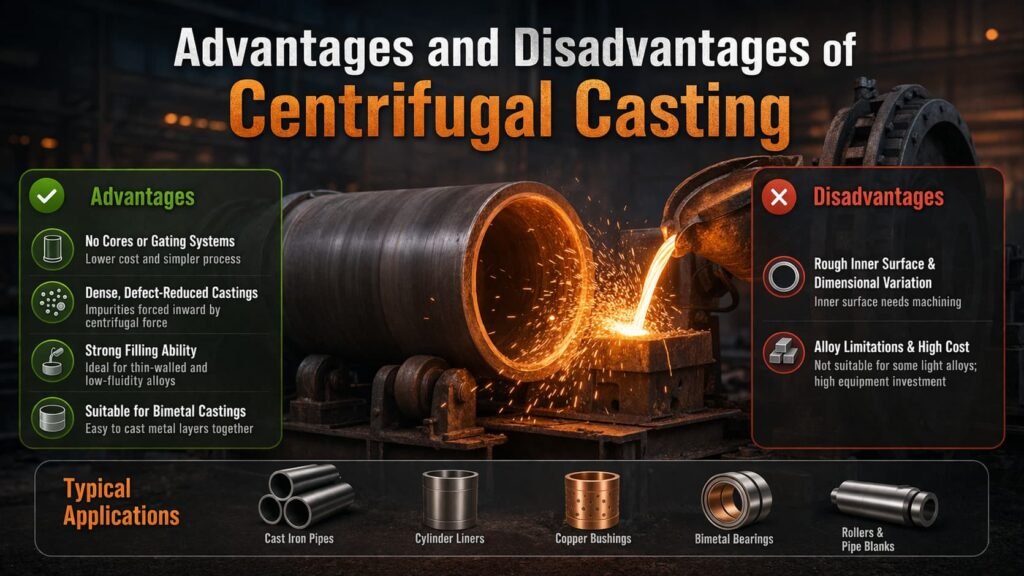
Centrifugal casting is a specialized casting process widely used for producing cylindrical and ring-shaped metal components. It is commonly applied in the manufacture of cast iron pipes, cylinder liners, copper bushings, bimetal bearings, heat-resistant steel rollers, and seamless pipe blanks. The process uses centrifugal force to distribute molten metal inside a rotating mold, which helps improve density and casting quality in suitable applications.
Applications of Centrifugal Casting
Centrifugal casting is especially suitable for round or hollow parts that require good density and reliable metallurgical quality. It is one of the main production methods for cast iron pipes, cylinder liners, and bearing bushings. Depending on the equipment and casting design, the process can be used for parts ranging from relatively small components to large castings weighing several tons.
Advantages of Centrifugal Casting
One important advantage of centrifugal casting is that when producing cylindrical castings with a free inner surface, cores and complicated gating systems can often be eliminated. This helps reduce tooling complexity and production cost.
Another major benefit is that the casting solidifies progressively from the outside toward the inside under the action of centrifugal force. During this process, gas, slag, and lighter impurities tend to move toward the inner surface, which improves the density of the main casting body and helps reduce defects such as shrinkage cavities, porosity, and slag inclusions.
Centrifugal casting also has strong filling capability, making it easier to produce certain alloys and thin-walled parts with relatively poor fluidity. In addition, the process is well suited to manufacturing bimetal components. For example, in plain bearing production, a copper alloy lining can be cast onto a steel backing to create a functional composite structure.
Disadvantages of Centrifugal Casting
Despite its advantages, centrifugal casting also has limitations. The inner diameter formed by the free surface may have relatively large dimensional variation, and the internal surface finish is usually rougher than the outer surface. Additional machining is often required to achieve the final dimensional and surface requirements.
The process is also not ideal for all alloys. Materials that are prone to significant density segregation, including some lead bronzes and light alloys such as aluminum and magnesium alloys, are generally less suitable for centrifugal casting. In addition, the required equipment investment is relatively high, which makes the process less economical for single-piece or small-batch production.
Conclusion
Centrifugal casting is an efficient process for producing dense cylindrical and hollow metal parts with reduced internal defects and strong metallurgical quality. It is especially effective for pipes, liners, bushings, and bimetal components. However, the process has limitations in inner surface accuracy, alloy suitability, and equipment cost, so it should be selected according to the specific product structure, material, and production volume.