Skip to content

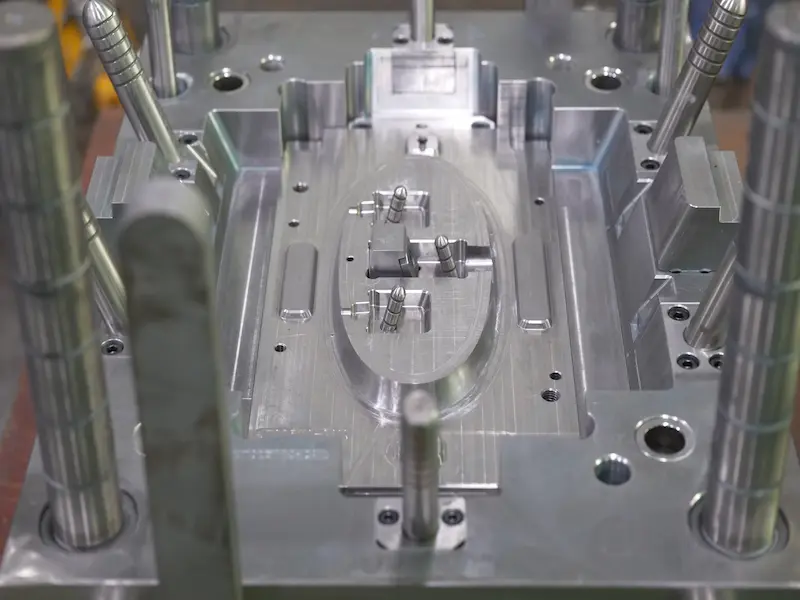
Mold manufacturing is different from general component machining because a mold is not only a collection of individual parts. All components must work together repeatedly under production conditions while maintaining dimensional accuracy, surface quality, movement, cooling, and long-term reliability.
Injection molds, die casting molds, rubber molds, and other tooling systems therefore require careful coordination between design, machining, EDM, grinding, fitting, polishing, inspection, and assembly.
1. High Dimensional Accuracy
Mold components often contain precision locating surfaces, shut-offs, guide features, sealing areas, inserts, sliders, cores, cavities, and ejector systems.
The dimensions of each individual component affect the final assembly. An acceptable tolerance on one part does not guarantee that the complete mold will function correctly if accumulated dimensional variation is not considered.
For this reason, mold manufacturing must control both individual dimensions and the relationship between mating components.
2. Complex Three-Dimensional Geometry
Many mold cavities and cores contain free-form surfaces, ribs, bosses, deep pockets, undercuts, and complex transitions.
These features may require CNC milling, EDM, Wire EDM, grinding, polishing, or a combination of several processes.
Machining strategy should be selected according to geometry, required surface finish, tool accessibility, material hardness, and dimensional tolerance.
3. High Surface Quality Requirements
The condition of a mold surface can directly affect the appearance and release of the molded product.
Depending on the application, surfaces may require machining finish, grinding, polishing, texture, engraving, coating, or other treatments.
Surface preparation must also avoid unwanted rounding of sharp edges or dimensional changes in sealing and shut-off areas.
4. Hardened Tool Materials
Molds frequently use pre-hardened or heat-treated tool steels. Hard materials improve wear resistance and mold life but can also increase machining difficulty and tool wear.
The manufacturing plan must consider whether components should be rough machined before heat treatment and finish machined afterward, or machined directly in the hardened condition.
Material selection and heat-treatment condition therefore influence both mold performance and manufacturing process.
5. Multiple Manufacturing Processes
Precision mold manufacturing normally involves more than CNC machining alone.
A typical tooling project may include:
- CNC milling and drilling
- Turning
- EDM
- Wire EDM
- Grinding
- Heat treatment
- Polishing and texturing
- Dimensional inspection
- Fitting and assembly
The sequence of these operations is important because one process can influence the accuracy or surface condition produced by another.
6. Tight Control of Mating Components
Slides, lifters, inserts, ejector components, parting surfaces, and shut-offs must fit correctly while still allowing reliable movement during production.
A fit that is too tight may cause seizure or excessive wear, while excessive clearance may result in flash, instability, or poor dimensional control.
Final fitting therefore requires both dimensional measurement and functional evaluation.
7. Thermal Considerations
Molds operate under repeated heating and cooling. Temperature affects dimensions, product shrinkage, cycle time, and tooling stability.
Cooling channels and thermal control features must be manufactured accurately and kept free from machining debris or leakage.
For some mold components, thermal expansion should also be considered when establishing clearances and operating conditions.
8. High Requirements for Inspection
Because mold components are assembled into one functional system, dimensional inspection should be performed throughout manufacturing rather than only after completion.
Inspection methods may include CMM measurement, height measurement, micrometers, calipers, gauges, projectors, and other equipment depending on the feature being checked.
Critical dimensions should be identified before machining so they can be controlled at the appropriate production stage.
9. Trial and Adjustment Are Part of Mold Manufacturing
The first mold trial is not only used to manufacture sample parts. It is also an important step for validating mold function.
The trial can reveal issues related to filling, venting, ejection, cooling, dimensional shrinkage, deformation, surface appearance, or moving mechanisms.
Adjustments after the trial should be based on measured results rather than uncontrolled modification of mold components.
10. Long-Term Maintainability
A production mold must operate for many cycles and may require periodic maintenance throughout its life.
Wear components, inserts, gates, vents, ejectors, slides, cooling connections, and other service areas should therefore be designed and manufactured with maintenance in mind.
Replaceable inserts can be particularly useful in areas that experience concentrated wear or where dimensional adjustment may be required.
Precision Mold Manufacturing Is a Coordinated Process
The quality of a mold cannot be determined by one machining operation alone. Successful tooling requires coordination between mold design, material selection, machining, heat treatment, EDM, finishing, fitting, inspection, mold trials, and production feedback.
The objective is not only to manufacture mold components according to drawings, but to create a complete tooling system that can repeatedly produce acceptable parts with stable operation and manageable maintenance.