Skip to content

How to Prevent Surface Galling in Stamping Dies and Formed Workpieces
Surface galling during the forming process is a common issue in stamping and drawing operations. It can damage both the mold and the workpiece, reduce part quality, and increase maintenance costs. To solve this problem effectively, the key is to reduce adhesive wear and improve the contact condition between the mold and the formed material.
1. Mold Material and Surface Treatment
One of the most effective solutions is to improve the mold itself. This can be done by changing the material of the punch or die, applying surface treatment to the mold, or selecting a more suitable die steel for the application.
In production practice, optimizing mold material and surface treatment is often the most economical and widely used method for reducing galling. Surface hardening, coating, polishing, and other treatments can help lower friction and improve wear resistance.
Heat treatment is also an important factor. The heat treatment process must match both the structure of the drawing die and the mechanical properties of the die steel. For large or complex tensile molds, uniform heating and controlled cooling are essential. Improper heat treatment may lead to dimensional deformation, cracking, excessive hardness, and increased machining difficulty, all of which raise production costs.
2. Surface Treatment of Raw Materials
The condition of the raw material also plays a major role in preventing strain and surface damage. Surface treatments such as phosphating, spraying, or other coating processes can create a non-metallic protective layer on the surface of the material.
This protective layer can significantly reduce or even eliminate galling between the workpiece and the mold. However, this method often requires additional equipment and processing steps, which increases production cost. For that reason, it is less commonly used in high-volume production unless the forming requirements are especially demanding.
3. Protective Layer Between the Workpiece and the Mold
Another possible solution is to place a film layer, such as PVC, between the mold and the forming material. In certain cases, this method can effectively prevent scratching and strain on the workpiece surface.
For automated production lines, film can sometimes be supplied continuously through a feeding mechanism. However, for single-cycle stamping operations, each workpiece must be fitted with a separate film layer, which reduces production efficiency and increases material waste.
As a result, this method is generally more suitable for small-batch production or large workpieces where surface protection is critical and productivity is less important.
4. Lubrication in Light-Load Forming
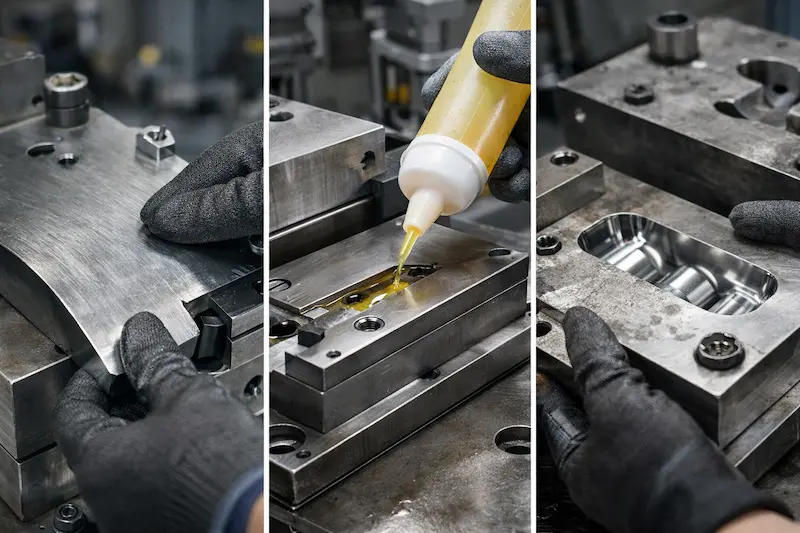
In applications where the forming load is relatively low, galling can often be reduced by using lubricating oil or lubricants containing extreme pressure additives. Proper lubrication helps reduce friction between the mold and the workpiece and can improve surface quality during forming.
5. Select the Right Method for the Actual Production Condition
There are many ways to solve the problem of scratching and galling between the workpiece surface and the punch or die. The most suitable method should be selected based on the size of the workpiece, forming load, production volume, material type, and processing requirements.
By combining suitable mold materials, surface treatments, lubrication, and protective measures, manufacturers can reduce mold wear, improve product appearance, and achieve more stable forming performance.