Skip to content

Advantages of Aspheric Optical Design in Modern Lens Systems
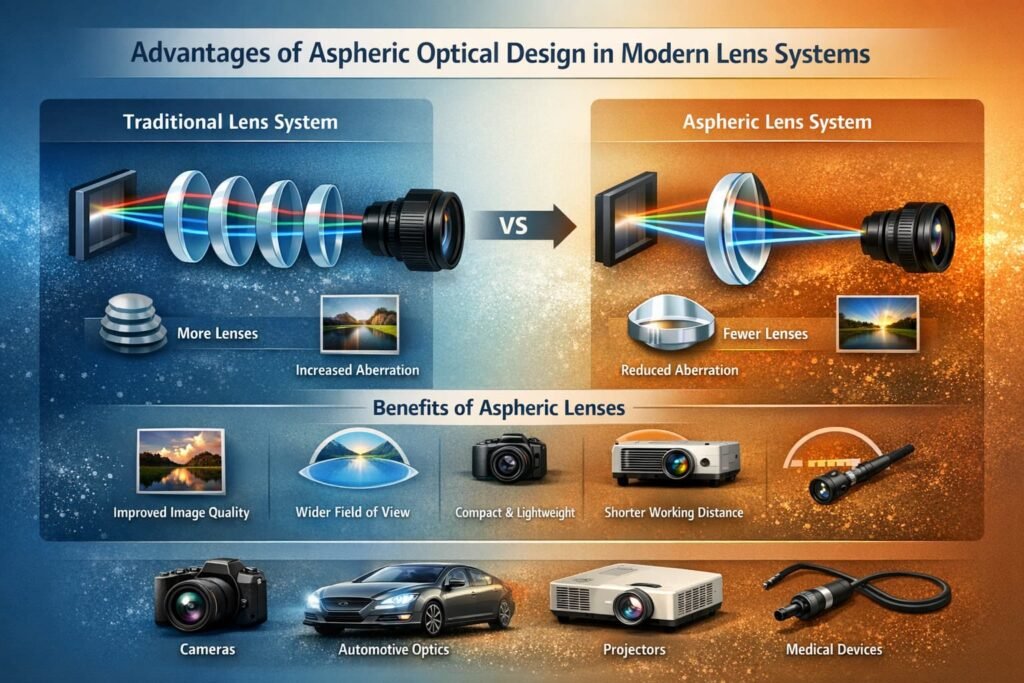
Aspheric optical surfaces are widely used in modern optical systems because they can achieve better optical performance than traditional spherical lenses. By using aspheric surfaces, designers can improve image quality, increase field of view, reduce aberrations, improve illumination uniformity, shorten working distance, and reduce the number of lenses required in the system.
Compared with conventional spherical optics, aspheric optics help simplify the optical structure while reducing overall size and weight. This makes them especially valuable in products that require compact dimensions, lightweight design, and high imaging performance.
Benefits of Aspheric Optical Surfaces
In many optical systems, aspheric surfaces can provide the same or even better optical performance than multiple spherical lenses combined. Their main advantages include:
- Improved relative aperture of the optical system
- Wider field of view
- Better image quality and reduced aberration
- Improved illumination uniformity
- Shorter working distance
- Reduced number of lenses in the system
- Lighter and more compact optical assemblies
Because of these advantages, aspheric optical components are commonly used in optical systems with large viewing angles, large apertures, high precision imaging requirements, and compact structural requirements.
Types of Aspheric Optical Surfaces
Aspheric optical components can be divided into several different categories depending on their shape and symmetry:
- Rotationally symmetric aspheric surfaces
- Non-rotationally symmetric aspheric surfaces
- Off-axis or non-symmetric central aspheric surfaces
- Array-type aspheric surfaces
Among these, rotationally symmetric aspheric surfaces are the most commonly used. These surfaces are typically generated by rotating a quadratic or higher-order curve around its central axis.
How Aspheric Surfaces Improve Optical Performance
Traditional spherical lenses only provide one basic surface shape, which limits the ability to correct optical aberrations. Aspheric surfaces allow designers to introduce additional surface parameters and localized shape modifications, making it possible to better correct wavefront errors and improve optical accuracy.
Because aspheric surfaces offer multiple design variables, they can often replace several spherical lenses with a single aspheric lens. This reduces the total number of components, simplifies assembly, lowers system weight, and improves optical efficiency. Humans, naturally, enjoy making optical systems unnecessarily complicated until one aspheric lens quietly does the work of three other parts and makes everyone pretend it was obvious all along.
Aspheric optical design continues to play an increasingly important role in cameras, automotive lighting, projection systems, medical devices, consumer electronics, and advanced industrial optical products.