Skip to content

Micro Injection Molding Technology for Tiny Plastic and Metal Precision Parts
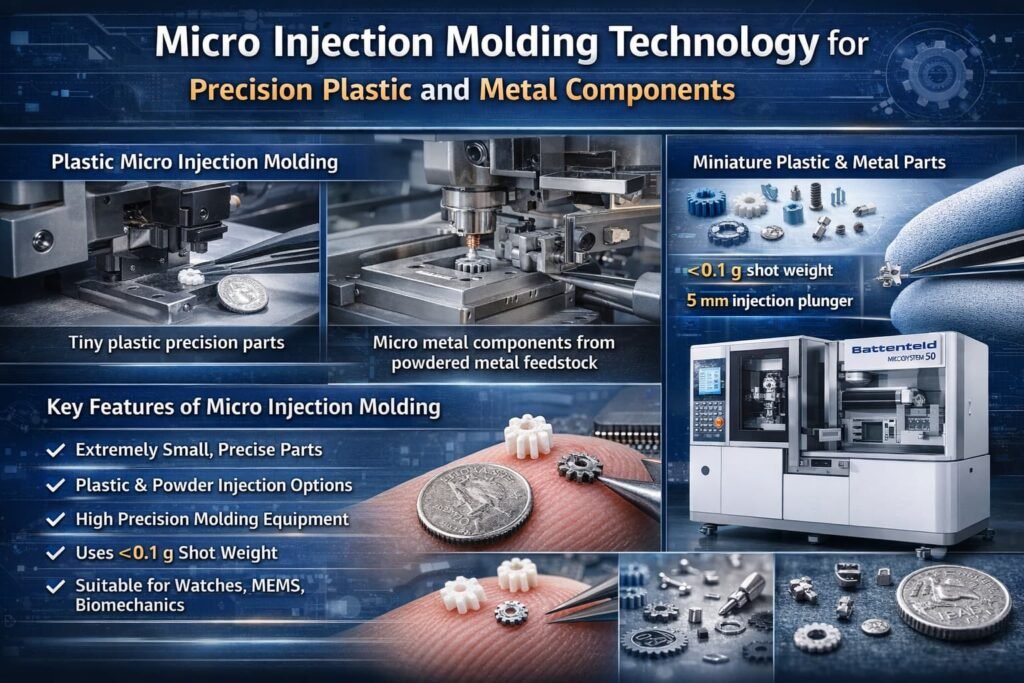
Micro injection molding technology can generally be divided into two categories according to the material used. One is plastic micro injection molding, which uses thermoplastic materials as the injection medium. The other is powder micro injection molding, which uses metal powder feedstock to produce miniature metal components.
Micro injection molding is essentially a miniaturized version of traditional injection molding technology. It first appeared in the 1980s and was mainly used in industries such as watches, cameras, and other products requiring extremely small and precise parts.
Compared with standard injection molding, micro injection molding is designed for components with extremely low shot weight, tiny feature size, and very strict dimensional tolerance requirements. Because of this, both the molding machine and the mold must provide extremely accurate control of injection volume, temperature, pressure, and cavity filling.
Plastic and Metal Micro Injection Molding
Plastic micro injection molding is widely used for small plastic components in consumer electronics, medical devices, sensors, precision connectors, and miniature mechanical parts. The process is suitable for producing thin walls, fine details, and complex geometries in very small products.
Powder micro injection molding uses metal powder materials and is suitable for tiny metal parts with complex shapes and high precision requirements. It is often used for miniature gears, watch components, medical tools, MEMS devices, and precision engineering products.
Development of Micro Injection Molding Machines
As the demand for smaller and more functional products continues to grow, injection molding machine manufacturers have developed specialized micro molding equipment with extremely small shot volumes and highly accurate control systems.
For example, Battenfeld developed the Microsystem 50, one of the first fully electric micro injection molding machines. This machine is suitable for manufacturing products used in watches, MEMS, and biomechanical industries. The molded part weight can be less than 0.1 g, while the injection plunger diameter is only 5 mm.
Research institutions have continued to improve this technology. The Plastics Processing Institute at RWTH Aachen University in Germany designed and developed a new micro injection molding concept machine with an even smaller injection volume than the Microsystem 50. In some cases, the shot weight can be reduced to less than 0.01 g. Humans apparently decided normal-sized parts were too boring, so now we build machines to inject components smaller than a grain of rice with terrifying precision.
Why Micro Injection Molding Matters
Micro injection molding technology is becoming increasingly important in industries that require tiny, lightweight, and highly precise components. It allows manufacturers to produce miniature plastic and metal parts with consistent quality, excellent repeatability, and high production efficiency.
For products with extremely small dimensions and complex structures, micro injection molding provides an efficient manufacturing solution that combines precision mold design, advanced machine control, and stable mass production capability.