Skip to content

Hot Forging, Warm Forging, and Cold Forging Explained
Forging is one of the two major metal forming processes alongside stamping. It uses forging equipment to apply pressure to a metal blank, causing plastic deformation and producing a forging with the required shape, dimensions, and mechanical properties.
Compared with cast parts, forging can eliminate internal defects such as porosity, shrinkage cavities, and looseness formed during metal smelting. Forging also improves the internal grain flow structure of the material, which gives forged parts better mechanical performance and higher reliability.
Because the metal flow lines remain continuous after forging, forged components usually have better strength, toughness, and fatigue resistance than cast or machined parts made from the same material.
For this reason, forgings are widely used for highly loaded and safety-critical parts in industries such as automotive, heavy machinery, aerospace, construction equipment, and industrial machinery.
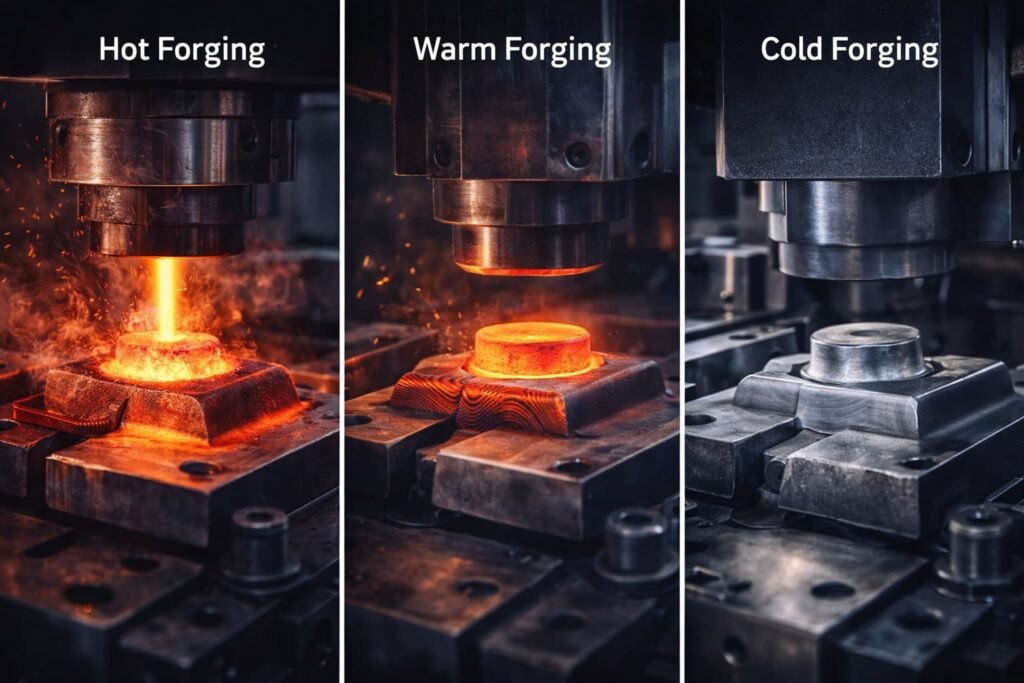
Hot Forging
Hot forging is performed above the metal recrystallization temperature. For steel materials, hot forging is generally carried out above 800°C.
At high temperatures, the material becomes softer and easier to deform, making it possible to produce large and complex forged parts with lower forming force.
Hot forging is the most commonly used forging method in industrial production.
Warm Forging
Warm forging is usually performed between 300°C and 800°C.
This process combines some of the advantages of both hot forging and cold forging. Compared with hot forging, warm forging can provide better dimensional accuracy and improved surface quality.
At the same time, it requires less forming force than cold forging and can reduce material waste.
Warm forging is commonly used for automotive parts, gears, shafts, and general mechanical components.
Cold Forging
Cold forging is performed at room temperature without heating the metal blank.
This process provides excellent dimensional accuracy, smoother surface finish, and high material utilization. In addition, cold forging can increase the strength of the part through work hardening.
However, cold forging requires much higher forming force and is usually more suitable for smaller parts with relatively simple shapes.
Cold forging is widely used for fasteners, automotive components, shafts, and precision mechanical parts.