 Skip to content

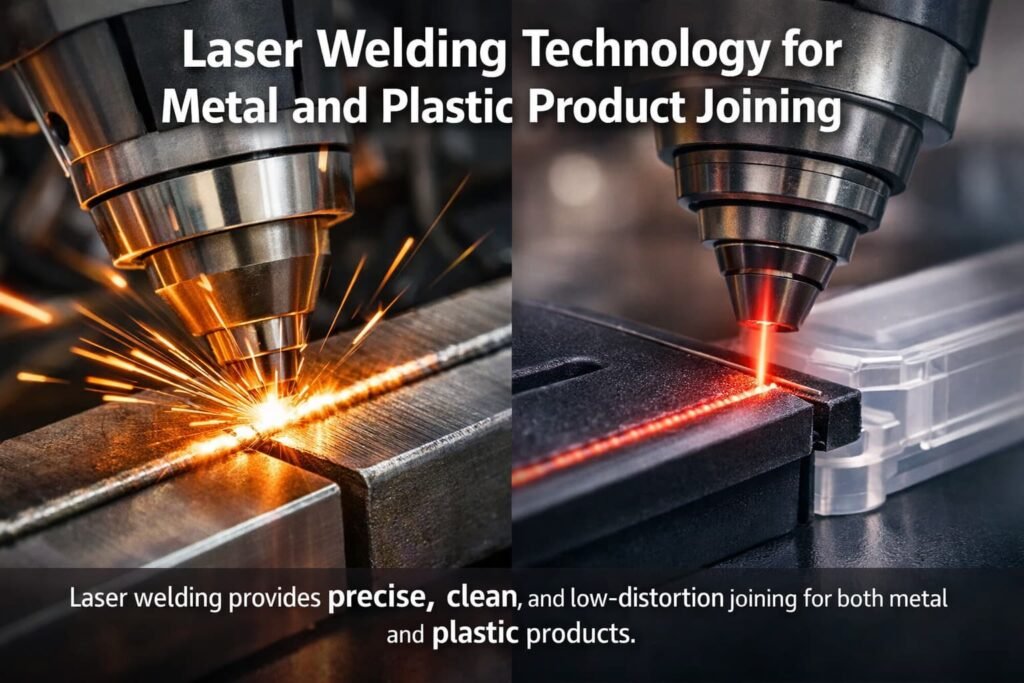
Laser Welding Technology for Metal and Plastic Product Joining
Laser welding technology offers a solution purification effect that helps improve weld quality and reduce contamination in the weld zone. It can be used for welding both similar and dissimilar metal materials and is especially suitable for materials with high melting points, high reflectivity, high thermal conductivity, or other difficult physical properties.
Because laser welding uses a concentrated energy source with very high energy density, it can provide precise local heating while minimizing heat-affected areas and distortion.
How Laser Welding Works
Laser welding works by reducing the laser beam power compared with laser cutting applications. Instead of cutting through the material, the laser locally melts the surface of the material, allowing two parts to fuse together after cooling.
The interaction between the laser beam and the material determines the welding quality. However, some lasers, especially CO2 lasers with a wavelength of 10.6 μm and YAG lasers with a wavelength of 1.06 μm, are initially reflected by the metal surface, which means the absorption rate is relatively low.
Once the metal begins to melt, the absorption rate increases significantly. This improves the efficiency of the welding process and creates better conditions for stable laser welding.
Common Types of Lasers Used in Welding
- YAG lasers
- CO2 lasers
- Semiconductor pump lasers
Each type of laser offers different advantages depending on the material, welding speed, penetration depth, and production requirements.
Laser Welding for Plastic Products
As materials and equipment continue to improve, laser welding has become an important joining method for plastic products. It is especially useful in industries that require fast, clean, and precise assembly methods.
Laser welding is commonly used for:
- Sensitive plastic products and electronic components
- Plastic parts with complex geometries
- Medical products with strict cleanliness requirements
- Plastic housings that require minimal surface damage
Many natural plastics and colored translucent plastics can be laser welded successfully. Common examples include:
- Polystyrene (PS)
- Polyvinyl chloride (PVC)
- Polypropylene (PP)
Advantages of Laser Welding
- High welding precision
- Small heat-affected zone
- Reduced material distortion
- Suitable for delicate and complex components
- Cleaner welding process with lower contamination risk
- Suitable for both metal and plastic materials
Conclusion
Laser welding technology provides a highly efficient and precise solution for joining both metals and plastics. Its ability to create strong welds with minimal heat damage makes it especially valuable for high-precision industries such as electronics, medical devices, automotive components, and advanced plastic products.
Humans spent decades inventing increasingly complicated ways to glue things together, only to realize that pointing a concentrated beam of light at two parts until they melt into one piece is sometimes the cleanest solution.


