Skip to content

Fuse Injection Molding for Complex Hollow Plastic Parts
Fuse injection molding, also known as molten core injection molding, has developed into a specialized branch of plastic injection molding. This process is especially useful for manufacturing hollow plastic parts with complex internal geometries that are difficult or impossible to produce with conventional molding methods.
As the demand for polymer components in the automotive industry continues to grow, fuse injection molding has been increasingly used for high-volume production of parts such as automotive intake manifolds, oil pipes, water pump impellers, centrifugal pump components, and aerospace pump housings.
Why Fuse Injection Molding Is Used
Many hollow plastic components with complicated internal channels are traditionally manufactured as two separate molded halves and then assembled together. However, this method often creates sealing problems, increases assembly costs, and reduces part reliability.
Fuse injection molding solves this problem by allowing the entire hollow component to be molded as a single integrated part with a fully enclosed internal structure.
How the Process Works
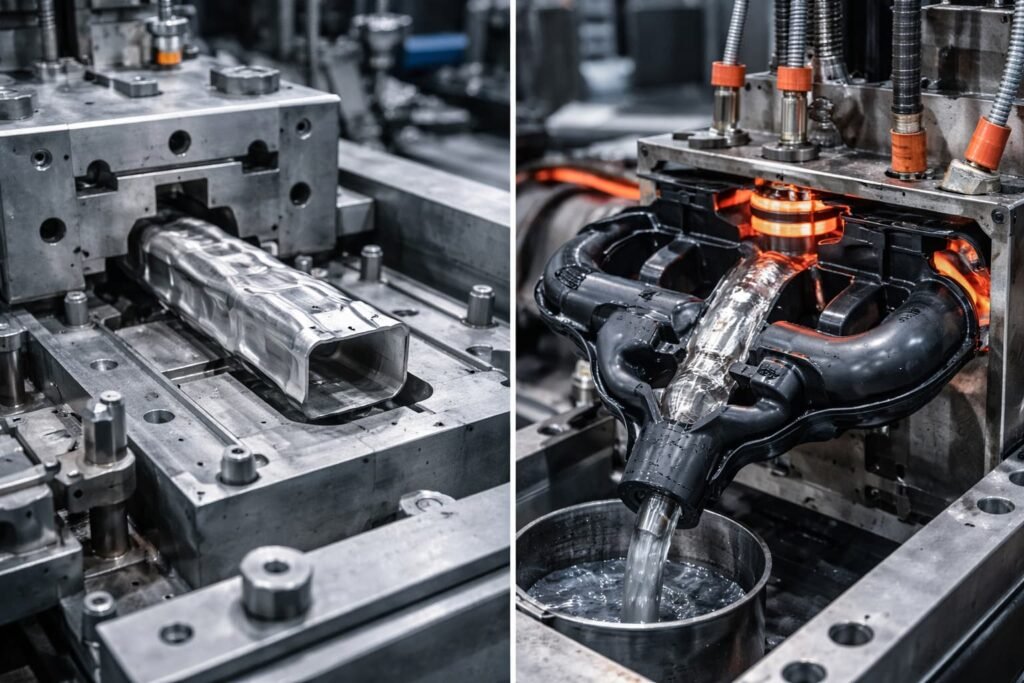
The process begins by producing a fusible core made from a low-melting-point alloy. This core is inserted into the injection mold cavity before the plastic material is injected around it.
After molding and cooling, the plastic part is removed from the mold with the alloy core still inside. The part is then reheated so that the metal core melts and drains out, leaving behind the hollow internal passage.
To shorten the melting time and reduce part deformation, manufacturers often combine oil heating with induction heating. Induction heating melts the alloy core from the inside outward, while heated oil helps remove any remaining alloy residue from the inner wall of the plastic component.
Core Materials Used in Fuse Injection Molding
The selection of core material is critical in this process. Conventional core materials cannot withstand the high injection pressure and melt flow during molding, nor can they maintain the dimensional accuracy required for plastic parts.
For this reason, low-melting-point alloys such as Sn-Bi and Sn-Pb are commonly used. These alloys provide sufficient strength during molding while still allowing easy removal after the part is formed.
Advantages of Fuse Injection Molding
Fuse injection molding is particularly suitable for complex, hollow products that cannot be easily produced through blow molding, gas-assisted injection molding, or traditional machining.
Although the process requires additional equipment for casting fusible cores and melting them after molding, it can still use standard injection molding machines and offers a high degree of design freedom for complex hollow plastic parts.