Skip to content

Three Theories of Non-Dendritic Grain Formation in Semi-Solid Processing
One of the core objectives of semi-solid metal processing is to produce non-dendritic equiaxed grains. Compared with traditional dendritic structures, equiaxed grains provide better flow behavior, improved mechanical properties, and more stable forming performance.
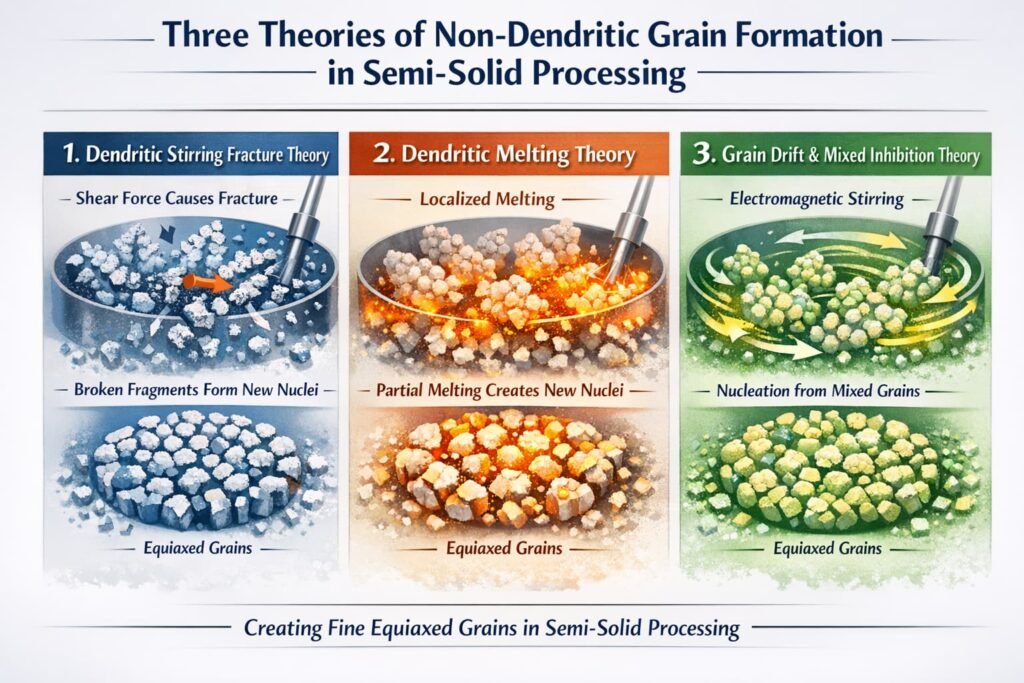
Several theories have been proposed to explain how non-dendritic grain structures form during semi-solid stirring and processing. The three most widely recognized theories are dendritic stirring fracture theory, dendritic melting theory, and grain drift and mixed inhibition theory.
1. Dendritic Stirring Fracture Theory
The dendritic stirring fracture theory suggests that crystal grains are broken during stirring in the semi-solid state. As the stirring speed and force increase, the shear force generated by the liquid phase acting on the dendritic grains also increases.
When the applied force exceeds the strength limit of the crystal grains, the dendrites fracture into smaller pieces. These broken fragments then act as new nucleation sites, forming additional crystal nuclei during solidification.
As a result, the original dendritic structure gradually transforms into a more uniform equiaxed grain structure with improved roundness and consistency.
2. Dendritic Melting Theory
The dendritic melting theory explains grain refinement through localized melting during the stirring process. During agitation, relative motion occurs between the liquid phase, the stirring tool, and the crystal grains.
This motion creates friction, which generates heat. If the stirring intensity is too high, the generated heat may not dissipate quickly enough, resulting in localized overheating in certain areas of the semi-solid structure.
Under these conditions, parts of the dendritic grains may partially melt and detach. These detached fragments then become new crystal nuclei, promoting the formation of fine equiaxed grains.
3. Grain Drift and Mixed Inhibition Theory
The grain drift and mixed inhibition theory is often used to explain grain refinement during electromagnetic stirring. In this process, mechanical grain fracture is considered less important.
Instead, strong stirring causes large-scale movement and mixing of the grains within the alloy. This movement promotes non-uniform nucleation throughout the solid-liquid structure and creates more new crystal nuclei.
The increased number of crystal nuclei helps reduce grain size, suppress grain anisotropy, and improve the roundness of the final grains.
Conclusion
Although these three theories explain non-dendritic grain formation in different ways, they all show that stirring, heat transfer, and nucleation behavior are critical factors in semi-solid processing.
Producing fine equiaxed grains is essential for improving alloy flow behavior, reducing defects, and achieving higher dimensional accuracy in semi-solid forming applications.